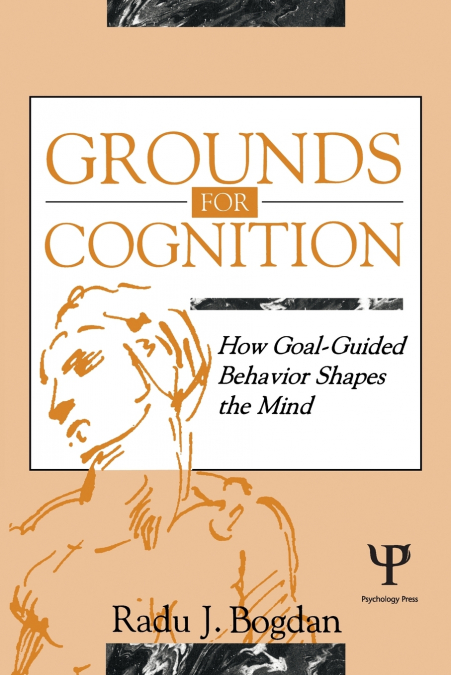

Grounds for Cognition

Grounds for Cognition

Radu J. Bogdan

94,95 €
IVA incluido
Disponible
Editorial:
Taylor & Francis Ltd
Año de edición:
1994
Materia
Psicología
ISBN:
9780805815924
94,95 €
IVA incluido
Disponible

Selecciona una librería:

  • Librería Samer Atenea
  • Librería Aciertas (Toledo)
  • Kálamo Books
  • Librería Perelló (Valencia)
  • Librería Elías (Asturias)
  • Donde los libros
  • Librería Kolima (Madrid)
  • Librería Proteo (Málaga)

Q: Why do organisms need cognition? A: To get information about their environments. Q: Why such information? A: Because organisms need to guide their behaviors to goals. Q: Why guidance? A: Because it leads to goal satisfaction. Q: Why goals? Cognition is a naturally selected response by genetic programs to the evolutionary pressure of guiding behaviors to goals. Organisms are material systems that maintain and replicate themselves by engaging their world in goal-directed ways. This is how guidance of behavior to goal grounds and explains cognition and the main forms in which it manages information. Guidance to goal also makes a difference to the understanding of human cognition. Simpler forms of cognition evolve to handle fixed informational transactions with the world, whereas human cognition evolves the abilities to script flexible goal situations that fit specific contexts of behavior. This teleoevolutionary approach has important implications for cognitive science, two of which are programmatic. One is that information that guides to goal is not exclusively cognitive; guidance is also affected by ecological facts and regularities as well as by design assumptions about them. The other implication is that the functional analyses dominant in cognitive science and philosophy of mind are incomplete and weak. They are incomplete in that they focus only on the explicitly encoded cognitive information and its behavioral consequences, thus ignoring the larger guidance arrangements; and weak because causal and functional relations implement but underdetermine goal-directed and goal-guided procesess. A work dealing expressly with the foundations of cognitive science, this book addresses basic but seldom-asked questions about the evolutionary rationale of cognition and the way this rationale has shaped the major types of cognition. It also provides a teleological answer to these basic questions in terms of goal directedness and particularly guidance of behavior to goal. In so doing, the work defends the scientific respectability and the explanatory necessity of teleology by showing that goal directedness characterizes the work of genetic programs.
Artículos relacionados

  • Drinkers of Infinity
    Arthur Koestler
    This selection of essays, book-reviews, broadcast talks and papers delivered to learned societies reflects the extraordinary breadth of Arthur Koestler’s interests. From the trial of Galileo to the pleasures of canoeing down the Loire, from a detailed examination of the ‘memory’ of flatworms to an equally detailed examination of the futility of quarantining dogs, the author wri...
    Disponible

    17,24 €

  • Gordy the Rabbit has ADHD
    Jessie Shepherd
    Often when people are given a mental health disorder diagnosis the weaknesses are clear and overwhelmingly emphasized, while the strengths are ignored or forgotten. The mental health children's book series 'What Mental Disorder?' challenges the stigma against therapy and diagnosis. It enlists the reader to view the character as a whole being and not as a mental issu...
    Disponible

    16,30 €

  • The Paradoxical Ego
    Eugene Halliday / Zhu Kabere
    Three particular themes are basic to this study. First, that the human race and its environment are involved in a slowly progressive process of revelation and understanding of its inherent features; and that we are all participating in this ongoing evolutionary cycle. Second, and closely related to the first tenet, man is not separable from his environment. We all share in this...
    Disponible

    14,56 €

  • On Being Human and When a Man Comes to Himself
    Woodrow Wilson
    Before he became the 28th President of the United States (1913-21), the 34th Governor of New Jersey (1911-13), or even the 13th President of Princeton University (1902-10), Woodrow Wilson (1856-1924) was a scholar and professor. In 1885, he received his Ph.D. in history and political science from Johns Hopkins University, and in 1897, he was granted tenure at Princeton Universi...
    Disponible

    6,28 €

  • Bridge Over The River Why
    David Cooper / Deborah Cooper
    'In Bridge Over the River Why, the Coopers have succeeded in a dual task documenting their own journey through the grief of losing their son Eli by suicide, while at the same time providing a valuable resource for anyone who has had to face the same terrible tragedy. They start with the premise that 'doing and feeling' are the key components of moving forward and have a core me...
  • Extraordinary Leadership
    Cher Holton
    This transformational leadership book, grounded in state-of-the-art research and proven by real-life application in the trenches, moves beyond traditional leadership theories to introduce you to seven incredible Core Abilities and shows you how to connect with them to become an Extraordinary Leader who can bring out the very best in your people.All the techniques in the world w...
    Disponible

    23,85 €