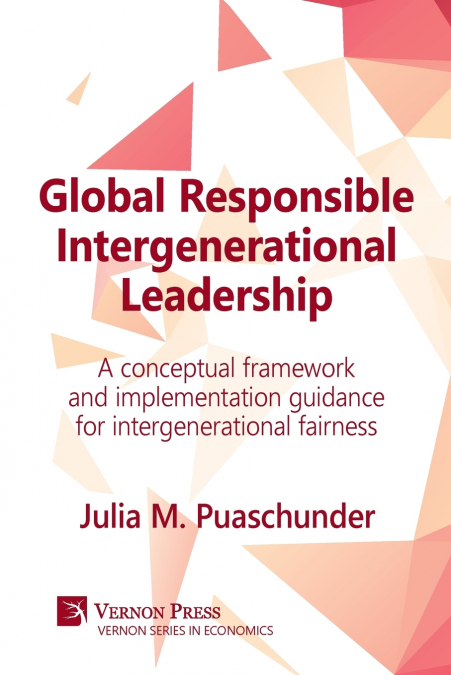

Global Responsible Intergenerational Leadership

Global Responsible Intergenerational Leadership

Global Responsible Intergenerational Leadership

Julia M Puaschunder

78,02 €
IVA incluido
Disponible
Editorial:
Vernon Art and Science
Año de edición:
2018
Materia
Economía del desarrollo y economías emergentes
ISBN:
9781622732418
78,02 €
IVA incluido
Disponible

Selecciona una librería:

  • Librería Samer Atenea
  • Librería Aciertas (Toledo)
  • Kálamo Books
  • Librería Perelló (Valencia)
  • Librería Elías (Asturias)
  • Donde los libros
  • Librería Kolima (Madrid)
  • Librería Proteo (Málaga)

Today's grand policy dilemmas, from climate change, to over-indebtedness, to demographic shifts, have momentous long-term implications. Future generations will be constrained by our present decisions to an extent that is without precedent in advanced capitalist democracies. This book is an extensively researched and reasoned appeal in favor of intergenerational fairness - the ability to provide to future generations an at least as favorable standard of living as that enjoyed today. Intergenerational equity is an essential consideration in finding lasting solutions to the multifaceted crises of our time. As an implicit contract and transfer between living and future generations, intergenerational equity avoids discriminating against future generations.The book aims to theoretically define intergenerational equity and to frame it as a natural behavioral law, capturing human ethicality bounds. It follows a long and distinguished tradition of scholarly discourse in turning to natural law for solutions to major social predicaments. Outlining some of the causes of the current intergenerational imbalances regarding climate change and over-indebtedness it sets the basis for understanding their drivers and implications. A central proposition is that the natural human drive towards intergenerational fairness can be the basis for the necessary behavioral responses: the human-imbued moral compass of natural law can be a useful complement, if not alternative, to public policy.This book fills an important gap. Despite a resurgence of literature, the economic and social dimensions of intergenerational equity remain underexplored. Existing literature misses a holistic ethical framework of decision-making failures that addresses intergenerational concerns. Whilst evolutionary grounded, intergenerational fairness has not been recognized as a natural behavioral law - a human-imbued drive being bound by human fallibility.Practical implications and recommendations in advancing an agenda for the advancement of intergenerational equity are provided. Attention is drawn to the problem of providing the required leadership to promote the idea of intergenerational equity as a guiding principle in corporate, social and policy action. This book contributes both theoretical and practical insights and will be of interest to economists, sociologists, public policy makers and corporate executives tasked with tackling the most pressing contemporary challenges of mankind.

Artículos relacionados

  • Business Innovation, Development, and Advancement in the Digital Economy
    Oncioiu
    Digital technologies maintain an important tool in today’s business economy. As the economy continues to change, businesses seek out solutions in order to enhance and develop their organization. Business Innovation, Development, and Advancement in the Digital Economy highlights the competitive advantages on the emerging digital economy. Bringing together the classic economy the...
  • Green Technology Applications for Enterprise and Academic Innovation
    Ezendu Ariwa
    In the age of corporate responsibility, green technology and sustainability continue to grip the consciousness of business and academic institutions. However, development of appropriate business-driven green applications requires an awareness of best practices of the green agenda. Green Technology Applications for Enterprise and Academic Innovation addresses the importance of g...
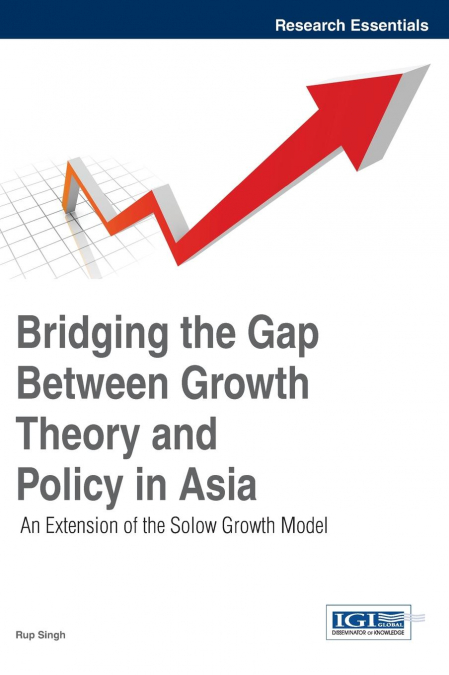
  • Bridging the Gap Between Growth Theory and Policy in Asia
    Rup Singh / Tatla Dar Singh
    Although economic growth is amongst the oldest of debates in Economics, there has been little advancement in growth theory since the classic works of Solow. As such, clear-cut answers to the context-specific determinants of growth, especially for developing countries, are rare. Bridging the Gap Between Growth Theory and Policy in Asia: An Extension of the Solow Growth Model add...
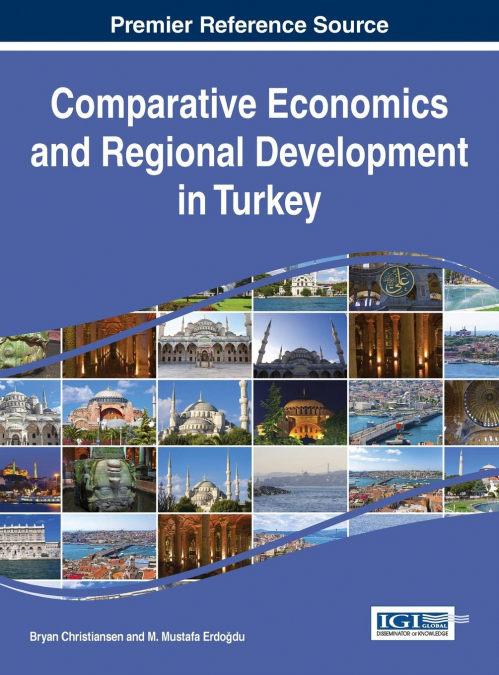
  • Comparative Economics and Regional Development in Turkey
    Bryan Christiansen / MMustafa Erdoğdu
    The rise of globalization has affected the ways in which nations maintain sustainable development and economic prosperity. Certain countries, such as Turkey, have evolved into a place of particular importance in the changing global economy. As such, it has become more important than ever to better understand the crucial role of such nations on an international scale. Comparativ...
  • Global Perspectives on Trade Integration and Economies in Transition
    Vasily Erokhin
    In the era of globalization, foreign trade has an immense impact upon modern economies. To succeed in the global marketplace, sustainable development in trade practices is an imperative goal for countries to reach. Global Perspectives on Trade Integration and Economies in Transition is an authoritative reference source for the latest research on the dynamics of transitional eco...
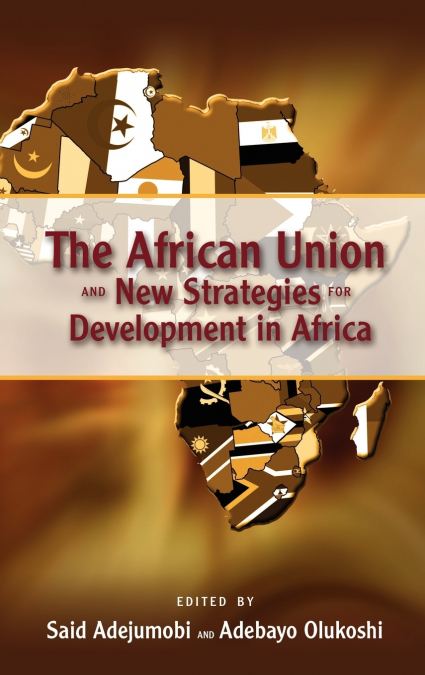
  • The African Union and New Strategies for Development in Africa
    The early twenty-first century witnessed remarkable attempts by Africa’s political leadership to promote regional integration as a means of fast-tracking economic progress, facilitating peace and security, consolidating democratic gains, and promoting the general welfare of the African people. The transition of the Organization of Unity (OAU) to the African Union (AU), as well ...