 Librería Samer Atenea
 Kálamo Books
 Librería Elías (Asturias)
 Librería Kolima (Madrid)
 Librería Proteo (Málaga)
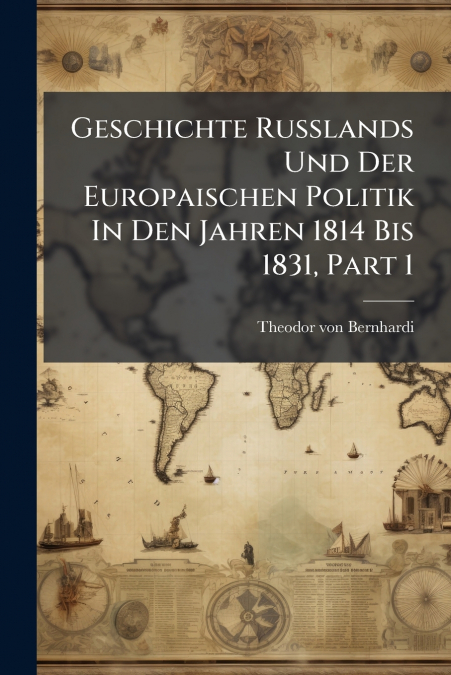
Delve into the intricate tapestry of 19th-century Europe with 'Geschichte Russlands Und Der Europaischen Politik In Den Jahren 1814 Bis 1831, Part 1,' a comprehensive historical analysis by Theodor von Bernhardi. This volume meticulously examines the pivotal role of Russia in European politics during a period of significant transformation, from the aftermath of the Napoleonic Wars to the rise of new political ideologies. Bernhardi’s detailed account explores the reigns of Alexander I and the early years of Nicholas I, shedding light on Russia’s evolving foreign policy and its interactions with other major European powers. Readers will gain valuable insights into the complex dynamics that shaped the continent’s political landscape, including the Congress of Vienna, the rise of nationalism, and the burgeoning revolutionary movements that would define the era. This historical work offers a rigorous and scholarly perspective, making it an essential resource for students, historians, and anyone interested in understanding the forces that shaped modern Europe. Discover the enduring legacy of Russia’s influence and its impact on the course of European history.This work has been selected by scholars as being culturally important, and is part of the knowledge base of civilization as we know it. This work was reproduced from the original artifact, and remains as true to the original work as possible. Therefore, you will see the original copyright references, library stamps (as most of these works have been housed in our most important libraries around the world), and other notations in the work.This work is in the public domain in the United States of America, and possibly other nations. Within the United States, you may freely copy and distribute this work, as no entity (individual or corporate) has a copyright on the body of the work.As a reproduction of a historical artifact, this work may contain missing or blurred pages, poor pictures, errant marks, etc. Scholars believe, and we concur, that this work is important enough to be preserved, reproduced, and made generally available to the public. We appreciate your support of the preservation process, and thank you for being an important part of keeping this knowledge alive and relevant.