
 Librería Samer Atenea
 Kálamo Books
 Librería Elías (Asturias)
 Librería Kolima (Madrid)
 Librería Proteo (Málaga)
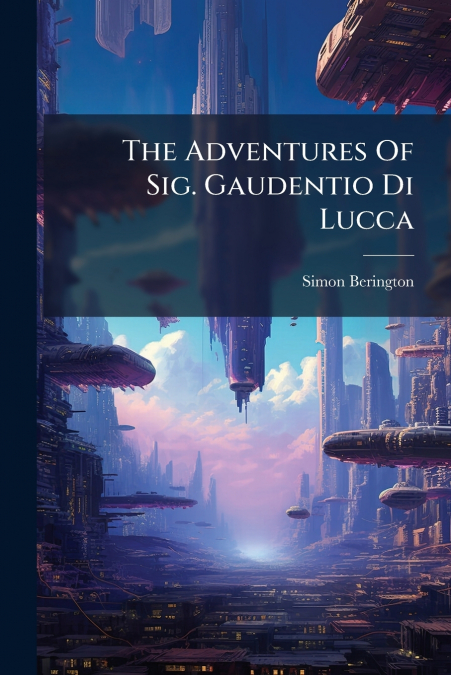
'Geschichte Des Gaudentio Von Lukka' is an early work of utopian fiction, originally written by Simon Berington. Presenting itself as a translated manuscript, the novel recounts the experiences of Gaudentio, an Italian man who finds himself in a remote, isolated land in the African desert. This hidden society offers a contrasting vision of social and political organization. Berington’s work provides a fascinating glimpse into 18th-century philosophical and social thought, exploring themes of ideal governance, education, and the nature of humanity. As a classic example of the 'lost world' genre, 'Geschichte Des Gaudentio Von Lukka' holds enduring appeal for readers interested in historical fiction, utopian literature, and early science fiction. Its blend of adventure and social commentary makes it a unique and thought-provoking read.This work has been selected by scholars as being culturally important, and is part of the knowledge base of civilization as we know it. This work was reproduced from the original artifact, and remains as true to the original work as possible. Therefore, you will see the original copyright references, library stamps (as most of these works have been housed in our most important libraries around the world), and other notations in the work.This work is in the public domain in the United States of America, and possibly other nations. Within the United States, you may freely copy and distribute this work, as no entity (individual or corporate) has a copyright on the body of the work.As a reproduction of a historical artifact, this work may contain missing or blurred pages, poor pictures, errant marks, etc. Scholars believe, and we concur, that this work is important enough to be preserved, reproduced, and made generally available to the public. We appreciate your support of the preservation process, and thank you for being an important part of keeping this knowledge alive and relevant.








![The Adventures Of Sig. Gaudentio Di Lucca [pseud.]]( https://distri.podiprint.com/imagenes/978/1/2/4/7/3/8/1/9781247381589_f_675x675.jpg "The Adventures Of Sig. Gaudentio Di Lucca [pseud.]")