
Inicio > Humanidades > Arqueología > Géoarchéologie de la transition Pléistocène-Holocène dans le nord-est pampéen (Buenos Aires, Argentine), Volume I
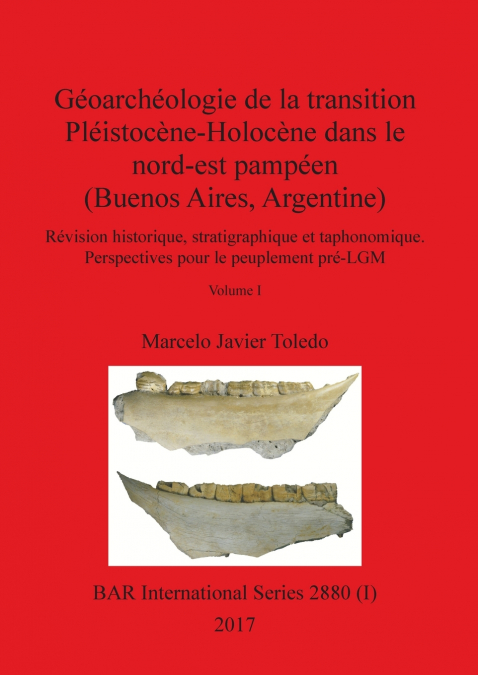
Géoarchéologie de la transition Pléistocène-Holocène dans le nord-est pampéen (Buenos Aires, Argentine), Volume I

Géoarchéologie de la transition Pléistocène-Holocène dans le nord-est pampéen (Buenos Aires, Argentine), Volume I

Marcelo Javier Toledo

131,74 €
IVA incluido
Disponible
Editorial:
British Archaeological Reports (Oxford) Ltd
Año de edición:
2017
Materia
Arqueología
ISBN:
9781407316208
131,74 €
IVA incluido
Disponible

Selecciona una librería:

  • Librería Samer Atenea
  • Librería Aciertas (Toledo)
  • Kálamo Books
  • Librería Perelló (Valencia)
  • Librería Elías (Asturias)
  • Donde los libros
  • Librería Kolima (Madrid)
  • Librería Proteo (Málaga)

Entre 1873 et 1884, Florentino Ameghino consacre tous ses efforts à documenter et prouver la coexistence des hommes et de la mégafaune pampéenne dans la vallée de Luján. Il identifie ainsi une dizaine de sites secondaires en dépôts fluviaux qui ne seront jamais réétudiés. L’objectif de cette étude est leur réévaluation et validation geoarchéologique. L’analyse séquentielle et l’étude de l’architecture des séquences fluviolacustres et des facies loessoides associées, datées par AMS, OSL et ESR entre 70.000 AP et 13.000 AP, permettent d’attribuer un âge pléistocène supérieur aux niveaux décrits au XIX siècle comme porteurs d’évidences culturelles. Ces dépôts sont scellés par une couche riche en matière organique (Black mat), signalant un changement climatique abrupt comme élément déclencheur des extinctions entre 13.000 et 12.000 AP. L’évidence taphonomique, notamment les marques de découpe et de percussion, a été étudiée à partir de collections paléontologiques, de pièces osseuses provenant des nouvelles fouilles et par l’expérimentation sur des carcasses. Ainsi sont présentés les résultats de ces expériences et des nombreux exemples d’os de mégafaune pampéenne striés, incisés et fracturés. Ces premiers résultats amènent à définir des modes de modification osseuse en mégafaune et à confirmer un peuplement des pampas pré-LGM, entre 45.000 AP et 30.000 AP.Ce volume fait partie d’un ensemble de deux volumes: ISBN 9781407316208 (Volume I); ISBN 9781407316215 (Volume II); ISBN 9781407315584 (Ensemble des deux volumes).Between 1873 and 1884, Florentino Ameghino set about documenting and proving the coexistence of man and Pampean megafauna in the Valley of Luján. He described several secondary sites in fluvial settings, which have not been re-evaluated since. The main objective of this work is the geoarchaeological reassessment of his findings. Facies and sequence stratigraphy analysis of Lujanian fluvio-lacustrine deposits, dated by AMS, OSL and ESR to between 70,000 BP and 13,000 BP, allow an assignment to the Upper Pleistocene age of most of the levels described in the 19th century as containing cultural evidence. These deposits are sealed by a black, rich organic matter layer (Black mat), indicating an abrupt climatic change that probably triggered extinction between 13,000 BP and 12,000 BP. Bone taphonomic evidence, such as cut and percussion marks, was analyzed in paleontological museum collections, new excavations and through carcass processing experiments. The results have allowed the author to define anthropic Pleistocene bone modification modes and to propose a pre-LGM peopling of the Pampas between 45,000 BP and 30,000 BP.This volume is part of a two volume set: ISBN 9781407316208 (Volume I); ISBN 9781407316215 (Volume II); ISBN 9781407315584 (Set of both volumes).
Artículos relacionados

  • PHAROS
    Branko Kirigin
    This is the first detailed study in English of the Greek settlement of Pharos (Stari Grad) on the Croatian island of Hvar. This book presents life in Stari Grad (a Parian colony of the 4th c BC) and its nearby vicinity in the period occurring more than two millennia ago. The author employs methods used in prehistoric and classical archaeology, as well as data known from written...
    Disponible

    90,79 €

  • Paleolithic Zooarchaeology in Practice
    Understanding Paleolithic animal exploitation requires a multifaceted approach. Inferences may derive from research on paleoenvironments and taphonomy, the development of new methods for interpreting seasonality patterns, and ethnoarchaeological observations. A full understanding of Paleolithic economies also requires a multiregional perspective. This volume brings together a g...
    Disponible

    55,20 €

  • Further Discoveries about the Surveying and Planning of Roman Roads in Northern Britain
    John Poulter
    The research reported in this monograph follows on directly from the findings that were reported in BAR 492, in which, among many other discoveries, the author recognised that the courses of both Roman Dere Street and Hadrian’s Wall had been underpinned by frameworks of long-distance alignments. Stimulated by the detection of several more of these alignments across northern Eng...
    Disponible

    65,21 €

  • A Decade of Discovery
    Edited by Sally Worrell, Geoff Egan, John Naylor, Kevin Leahy and Michael Lewis.In 2007 the Portable Antiquities Scheme (PAS) marked its tenth anniversary by holding a conference at which speakers, both from within the Scheme and outside gave a series of papers that demonstrated the research potential of recording finds of archaeological objects made by members of the public. T...
    Disponible

    117,84 €

  • Le Camp à Challignac (Charente) au IIIe millénaire av. J.-C.
    Claude Burnez
    Un établissement complexe de la culture d’Artenac dans le Centre-Ouest de la FranceThis fortified enclosure has been known since the middle of the 19th century, but the size and the state of preservation (with the height of the rampart estimated optimistically at 10 metres!) suggested an attribution to the Gallo-Romans or a 'Camp des Anglais'. Extensive woodland covered...
    Disponible

    238,69 €

  • La Necropoli di Campovalano
    This volume, investigating the necropolis and sequences of 607 tombs, completes the publication of the site of Campovalano (predominately Late BA to 5th BC) in the region of Teramo, the northernmost province of Abruzzo, Italy (see BAR 1177, 2003). The finds include important oriental style archaic material.Contributions from: Giorgio Baratti, Carla Buoite, Cristina Chiaramonte ...
    Disponible

    220,16 €

Otros libros del autor