 Librería Samer Atenea
 Kálamo Books
 Librería Elías (Asturias)
 Librería Kolima (Madrid)
 Librería Proteo (Málaga)
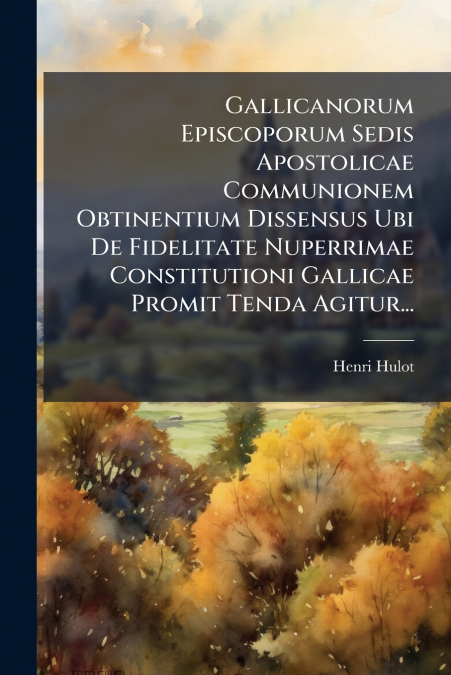
This Latin text, 'Gallicanorum Episcoporum Sedis Apostolicae Communionem Obtinentium Dissensus Ubi De Fidelitate Nuperrimae Constitutioni Gallicae Promit Tenda Agitur...', by Henri Hulot, delves into the dissension among Gallican bishops concerning their communion with the Apostolic See. The core issue revolves around the fidelity to the recent French constitution. This historical document offers insights into the complex relationship between the Catholic Church and the French state during a period of significant political and religious upheaval. It is an invaluable resource for scholars of religious history, French history, and the history of political thought, shedding light on the tensions and negotiations that shaped the era. The book examines the nuances of Gallicanism and its impact on ecclesiastical governance and the relationship between secular and religious powers.This work has been selected by scholars as being culturally important, and is part of the knowledge base of civilization as we know it. This work was reproduced from the original artifact, and remains as true to the original work as possible. Therefore, you will see the original copyright references, library stamps (as most of these works have been housed in our most important libraries around the world), and other notations in the work.This work is in the public domain in the United States of America, and possibly other nations. Within the United States, you may freely copy and distribute this work, as no entity (individual or corporate) has a copyright on the body of the work.As a reproduction of a historical artifact, this work may contain missing or blurred pages, poor pictures, errant marks, etc. Scholars believe, and we concur, that this work is important enough to be preserved, reproduced, and made generally available to the public. We appreciate your support of the preservation process, and thank you for being an important part of keeping this knowledge alive and relevant.