 Librería Samer Atenea
 Kálamo Books
 Librería Elías (Asturias)
 Librería Kolima (Madrid)
 Librería Proteo (Málaga)
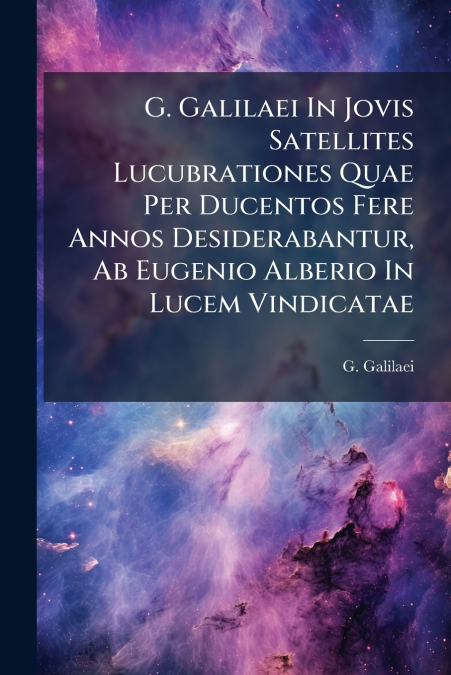
G. Galilaei In Jovis Satellites Lucubrationes Quae Per Ducentos Fere Annos Desiderabantur, Ab Eugenio Alberio In Lucem Vindicatae presents newly discovered writings by G. Galilaei (Galileo Galilei) regarding his observations of Jupiter’s satellites. This work, brought to light by Eugenio Alberio after being lost for nearly two centuries, offers invaluable insight into Galileo’s groundbreaking astronomical research.Written in Italian, this edition allows readers to delve into the original language of Galileo’s scientific thought, exploring his methods and discoveries related to the celestial bodies orbiting Jupiter. This text is essential for historians of science, astronomers, and anyone interested in the development of modern scientific thought. The rediscovery of these lucubrations enhances our understanding of Galileo’s contributions and the scientific revolution he helped to ignite.This work has been selected by scholars as being culturally important, and is part of the knowledge base of civilization as we know it. This work was reproduced from the original artifact, and remains as true to the original work as possible. Therefore, you will see the original copyright references, library stamps (as most of these works have been housed in our most important libraries around the world), and other notations in the work.This work is in the public domain in the United States of America, and possibly other nations. Within the United States, you may freely copy and distribute this work, as no entity (individual or corporate) has a copyright on the body of the work.As a reproduction of a historical artifact, this work may contain missing or blurred pages, poor pictures, errant marks, etc. Scholars believe, and we concur, that this work is important enough to be preserved, reproduced, and made generally available to the public. We appreciate your support of the preservation process, and thank you for being an important part of keeping this knowledge alive and relevant.