
Inicio > Lenguas > Lingüistica > Fuzzy Quantifiers
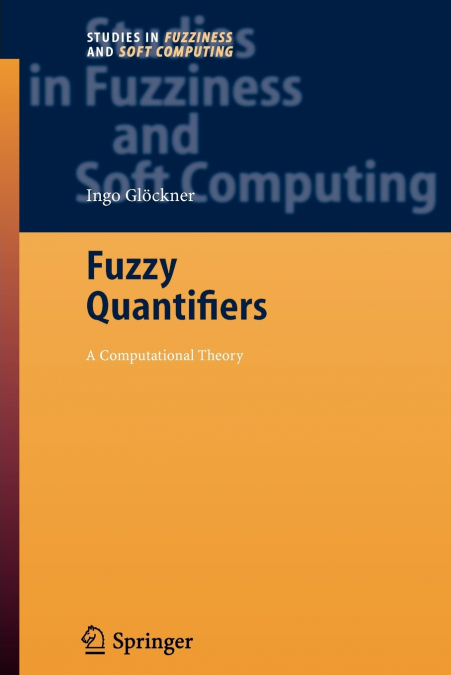
Fuzzy Quantifiers

Fuzzy Quantifiers

Ingo Glöckner

268,28 €
IVA incluido
Disponible
Editorial:
Springer Nature B.V.
Año de edición:
2010
Materia
Lingüistica
ISBN:
9783642067433
268,28 €
IVA incluido
Disponible

Selecciona una librería:

  • Librería Samer Atenea
  • Librería Aciertas (Toledo)
  • Kálamo Books
  • Librería Perelló (Valencia)
  • Librería Elías (Asturias)
  • Donde los libros
  • Librería Kolima (Madrid)
  • Librería Proteo (Málaga)

From a linguistic perspective, it is quanti?cation which makes all the di?- ence between 'having no dollars' and 'having a lot of dollars'. And it is the meaning of the quanti?er 'most' which eventually decides if 'Most Ame- cans voted Kerry' or 'Most Americans voted Bush' (as it stands). Natural language(NL)quanti?erslike'all','almostall','many'etc. serveanimp- tant purpose because they permit us to speak about properties of collections, as opposed to describing speci?c individuals only; in technical terms, qu- ti?ers are a ’second-order’ construct. Thus the quantifying statement 'Most Americans voted Bush' asserts that the set of voters of George W. Bush c- prisesthemajorityofAmericans,while'Bushsneezes'onlytellsussomething about a speci?c individual. By describing collections rather than individuals, quanti?ers extend the expressive power of natural languages far beyond that of propositional logic and make them a universal communication medium. Hence language heavily depends on quantifying constructions. These often involve fuzzy concepts like 'tall', and they frequently refer to fuzzy quantities in agreement like 'about ten', 'almost all', 'many' etc. In order to exploit this expressive power and make fuzzy quanti?cation available to technical applications, a number of proposals have been made how to model fuzzy quanti?ers in the framework of fuzzy set theory. These approaches usually reduce fuzzy quanti?cation to a comparison of scalar or fuzzy cardinalities [197, 132].

Artículos relacionados

  • User-Centered Computer Aided Language Learning
    Giorgos Zacharia / Panayiotis Zaphiris
    ...
  • Deep Learning for Natural Language Processing
    Marco Antonio Valenzuela-Escárcega / Mihai Surdeanu
    ...
    Disponible

    47,60 €

  • Deep Learning for Natural Language Processing
    Marco Antonio Valenzuela-Escárcega / Mihai Surdeanu
    ...
  • Lecciones sobre espinosa medrano
    Luis Jaime Cisneros Vizquerra
    La obra de Juan de Espinosa Medrano, apodado en su tiempo «El Lunarejo» (c. 1629-1688), fue uno de los mayores focos de interés académico de Luis Jaime Cisneros (1921-2011). En 1980 aparecieron sus primeros trabajos dedicados a estudiar los textos capitales de Espinosa Medrano (el Apologético en favor de don Luis de Góngora, la Panegírica declamación por la protección de las ci...
    Disponible

    17,63 €

  • Lyre Book
    Matthew Kilbane
    Redefines modern lyric poetry at the intersection of literary and media studies.In The Lyre Book, Matthew Kilbane urges literary scholars to consider lyric not as a genre or a reading practice but as a media condition: the generative tension between writing and sound. In addition to clarifying issues central to the study of modern poetry--including its proximity to popular song...
    Disponible

    50,84 €

  • Translation-mediated Communication in a Digital World
    David Ashworth / Minako O’Hagan
    The Internet is accelerating globalization by exposing organizations and individuals to global audiences. This in turn is driving teletranslation and teleinterpretation, new types of multilingual support, which are functional in digital communications environments. The book describes teletranslation and teleinterpretation by exploring a number of key emerging contexts for langu...
    Disponible

    45,19 €

Otros libros del autor