Fuzzy Preference Modelling and Multicriteria Decision Support

Fuzzy Preference Modelling and Multicriteria Decision Support

J.C. Fodor / M.R. Roubens

206,41 €
IVA incluido
Consulta disponibilidad
Editorial:
Springer Nature B.V.
Año de edición:
1994
Materia
Toma de decisiones en la gestión de empresas
ISBN:
9780792331162

Selecciona una librería:

  • Librería Samer Atenea
  • Librería Aciertas (Toledo)
  • Kálamo Books
  • Librería Perelló (Valencia)
  • Librería Elías (Asturias)
  • Donde los libros
  • Librería Kolima (Madrid)
  • Librería Proteo (Málaga)

The encounter, in the late seventies, between the theory of triangular norms, issuing frorn stochastic geornetry, especially the works of Menger, Schweizer and Sklar, on the one band, and the theory of fuzzy sets due to Zadeh, 10n the other band has been very fruitful. Triangular norms have proved to be ready-rnade mathematical rnodels of fuzzy set intersections and have shed light on the algebraic foundations of fuzzy sets. One basic idea behind the study of triangular norms is to solve functional equations that stern frorn prescribed axioms describing algebraic properties such as associativity. Alternative operations such as rneans have been characterized in a similar way by Kolmogorov, for instance, and the rnethods for solving functional equations are now weil established thanks to the efforts of Aczel, among others. One can say without overstaternent that the introduction of triangular norms in fuzzy sets has strongly influenced further developrnents in fuzzy set theory, and has significantly contributed to its better acceptance in pure and applied rnathematics circles. The book by Fodor and Roubens systematically exploits the benefits of this encounter in the- analysis of fuzzy relations. The authors apply functional equation rnethods to notions such as equivalence relations, and various kinds of orderings, for the purpose of preference rnodelling. Centtal to this book is the rnultivalued extension of the well-known result claiming that any relation expressing weak preference can be separated into three cornponents respectively describing strict preference, indifference and incomparability.


Artículos relacionados

  • Ethics and Decision-Making for Sustainable Business Practices
    Ionica Oncioiu
    Alongside increasing demands for transparency and accountability, business governance is transforming due to decades of economic turmoil, regulatory reform, and technological change. There is now a holistic approach to this concept, as it is no longer just about running companies and organization efficiently. Ethics and Decision-Making for Sustainable Business Practices is a cr...
  • Decisions
    Robert L. Dilenschneider
    ...
    Disponible

    15,88 €

  • Treasure Hunt
    Michael Hinkle
    Sales Isn’t a Rat Race...It’s a Treasure Hunt.The question is...how do you get to the treasure? With over thirty years of sales experience-from owning his own business to commission-only roles-Michael Hinkle shares the mindsets and practices he’s used to cultivate a multimillion-dollar sales career. With a refreshingly straightforward and simple perspective on how to build a th...
    Disponible

    16,19 €

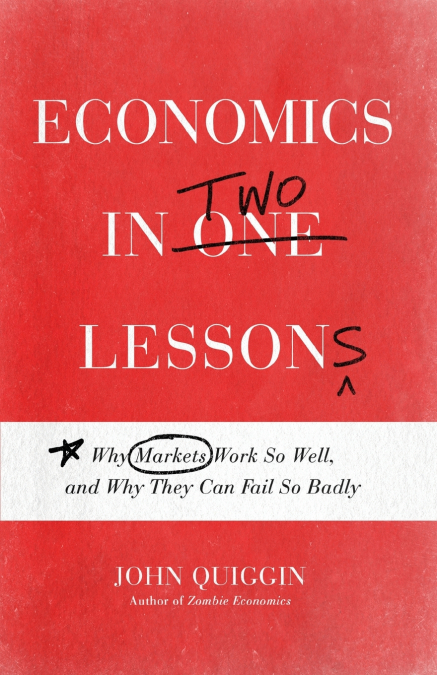
  • Economics in Two Lessons
    John Quiggin
    A masterly introduction to the key ideas behind the successes-and failures-of free-market economicsSince 1946, Henry Hazlitt’s bestselling Economics in One Lesson has popularized the belief that economics can be boiled down to one simple lesson: market prices represent the true cost of everything. But one-lesson economics tells only half the story. It can explain why markets of...
    Disponible

    30,15 €

  • Hunting for True Wealth
    Dave Young
    Not all wealth is financial. No matter your age, career, or life experience, true wealth is within reach.Financial investing is a lot like big game hunting. They both come with risk and reward. They both require discipline, research, and excellent timing. They both offer clues to what it means to be truly wealthy.Hunting for True Wealth is your fun and informative guide to livi...
    Disponible

    17,77 €

  • ¿Quién decide quién decide?
    TED J. RAU
    Se forman tantos grupos y muchos de ellos se desvanecen. ¿Qué distingue a los grupos que crecen y prosperan de los que se desvanecen y fracasan? Los factores de éxito están bien estudiados, aunque las lecciones aprendidas difícilmente se incorporan al diseño de quienes inician grupos. Eso tiene sentido: los grupos se forman porque las personas sienten la urgencia de un cambio e...
    Disponible

    19,24 €

Otros libros del autor

  • Fuzzy Preference Modelling and Multicriteria Decision Support
    J.C. Fodor / M.R. Roubens
    The encounter, in the late seventies, between the theory of triangular norms, issuing frorn stochastic geornetry, especially the works of Menger, Schweizer and Sklar, on the one band, and the theory of fuzzy sets due to Zadeh, 10n the other band has been very fruitful. Triangular norms have proved to be ready-rnade mathematical rnodels of fuzzy set in...
    Disponible

    207,76 €