

 Librería Samer Atenea
 Kálamo Books
 Librería Elías (Asturias)
 Librería Kolima (Madrid)
 Librería Proteo (Málaga)
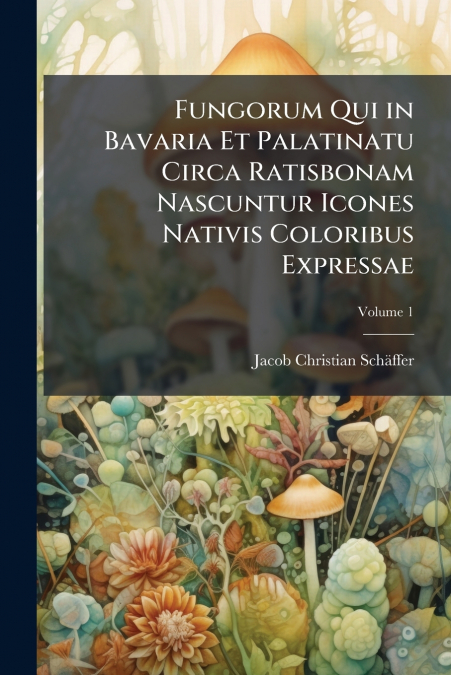
Fungorum Qui in Bavaria Et Palatinatu Circa Ratisbonam Nascuntur Icones Nativis Coloribus Expressae, Volume 1, is a landmark work by Jacob Christian Schäffer, published in 1762. This volume presents a detailed and visually stunning catalog of fungi found in Bavaria and the Palatinate region around Ratisbon. Written in Latin, the book offers meticulously illustrated depictions of various fungal species, rendered in their natural colors, providing invaluable insights into the botanical knowledge of the 18th century.Schäffer’s work is not only a scientific treatise but also a testament to the art of botanical illustration. The precise and vibrant illustrations make this book an essential resource for mycologists, botanists, and historians of science, as well as those interested in the natural history of Bavaria. This edition preserves the historical and scientific value of Schäffer’s original observations and artistic representations, making it accessible to a contemporary audience.This work has been selected by scholars as being culturally important, and is part of the knowledge base of civilization as we know it. This work was reproduced from the original artifact, and remains as true to the original work as possible. Therefore, you will see the original copyright references, library stamps (as most of these works have been housed in our most important libraries around the world), and other notations in the work.This work is in the public domain in the United States of America, and possibly other nations. Within the United States, you may freely copy and distribute this work, as no entity (individual or corporate) has a copyright on the body of the work.As a reproduction of a historical artifact, this work may contain missing or blurred pages, poor pictures, errant marks, etc. Scholars believe, and we concur, that this work is important enough to be preserved, reproduced, and made generally available to the public. We appreciate your support of the preservation process, and thank you for being an important part of keeping this knowledge alive and relevant.






