
Inicio > Matemáticas y ciencia > Química > Química física > Fundamentals of Time-Dependent Density Functional Theory
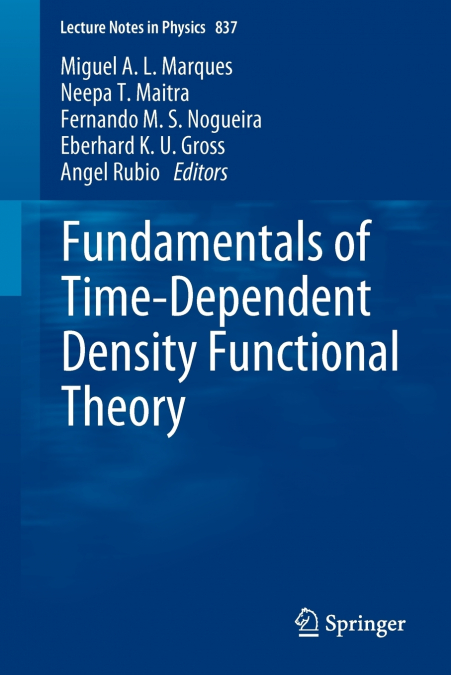
Fundamentals of Time-Dependent Density Functional Theory

Fundamentals of Time-Dependent Density Functional Theory


144,78 €
IVA incluido
Disponible
Editorial:
Springer Nature B.V.
Año de edición:
2012
Materia
Química física
ISBN:
9783642235177
144,78 €
IVA incluido
Disponible

Selecciona una librería:

  • Librería Samer Atenea
  • Librería Aciertas (Toledo)
  • Kálamo Books
  • Librería Perelló (Valencia)
  • Librería Elías (Asturias)
  • Donde los libros
  • Librería Kolima (Madrid)
  • Librería Proteo (Málaga)

There have been many significant advances in time-dependent density functional theory over recent years, both in enlightening the fundamental theoretical basis of the theory, as well as in computational algorithms and applications. This book, as successor to the highly successful volume Time-Dependent Density Functional Theory (Lect. Notes Phys. 706, 2006) brings together for the first time all recent developments in a systematic and coherent way. First, a thorough pedagogical presentation of the fundamental theory is given, clarifying aspects of the original proofs and theorems, as well as presenting fresh developments that extend the theory into new realms-such as alternative proofs of the original Runge-Gross theorem, open quantum systems, and dispersion forces to name but a few. Next, all of the basic concepts are introduced sequentially and building in complexity, eventually reaching the level of open problems of interest. Contemporary applications of the theory are discussed, from real-time coupled-electron-ion dynamics, to excited-state dynamics and molecular transport. Last but not least, the authors introduce and review recent advances in computational implementation, including massively parallel architectures and graphical processing units. Special care has been taken in editing this volume as a multi-author textbook, following a coherent line of thought, and making all the relevant connections between chapters and concepts consistent throughout. As such it will prove to be the text of reference in this field, both for beginners as well as expert researchers and lecturers teaching advanced quantum mechanical methods to model complex physical systems, from molecules to nanostructures, from biocomplexes to surfaces, solids and liquids. From the reviews of LNP 706:'This is a well structured text, with a common set of notations and a single comprehensive and up-to-date list of references, rather than just a compilation of research articles. Because of its clear organization, the book can be used by novices (basic knowledge of ground-state DFT is assumed) and experienced users of TD-DFT, as well as developers in the field.' (Anna I. Krylov, Journal of the American Chemical Society, Vol. 129 (21), 2007) 'This book is a treasure of knowledge and I highly recommend it. Although it is a compilation of chapters written by many different leading researchers involved in development and application of TDDFT, the contributors have taken great care to make sure the book is pedagogically sound and the chapters complement each other [...]. It is highly accessible to any graduate student of chemistry or physics with a solid grounding in many-particle quantum mechanics, wishing to understand both the fundamental theory as well as the exponentially growing number of applications. [...] In any case, no matter what your background is, it is a must-read and an excellent reference to have on your shelf.' Amazon.com, October 15, 2008, David Tempel (Cambridge, MA)
Artículos relacionados

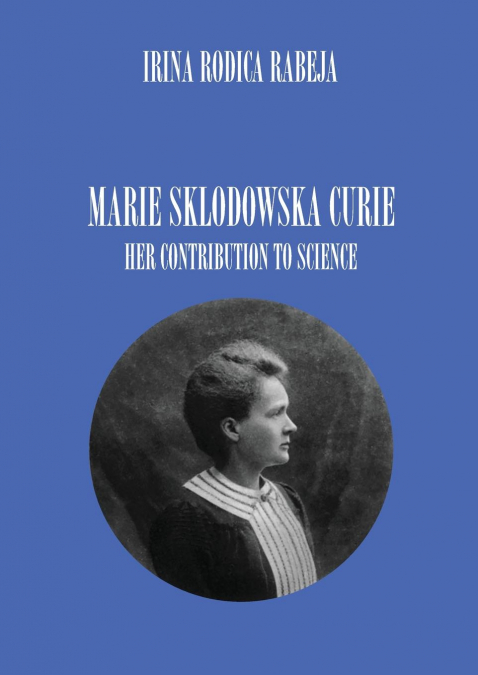
  • MARIE SKLODOWSKA CURIE
    Irina Rodica Rabeja
    Marie Sklodowska Curie (7 November 1867 – 4 July 1934) was one of the greatest scientific minds that brought a fundamental contribution in science opening the door to the understanding/knowledge of the structure of the atom in the 20th century.                 Marie Sklodowska Curie’s hypothesis that the spontaneous emission of powerful rays by some chemical elements, emission ...
    Disponible

    89,28 €

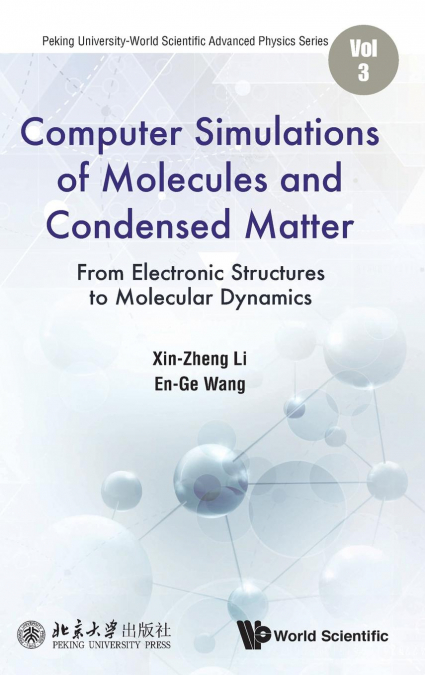
  • COMPUTER SIMULATIONS OF MOLECULES AND CONDENSED MATTER
    En-Ge Wang / LI XIN-ZHENG / Xin-Zheng Li / XIN-ZHENG LI & EN-GE WANG
    This book provides a relatively complete introduction to the methods used in computational condensed matter. A wide range of electronic structure theories are introduced, including traditional quantum chemistry methods, density functional theory, many-body perturbation theory, and more. Molecular dynamics simulations are also discussed, with extensions to enhanced sampling and ...
  • APPLIED THEORETICAL ORGANIC CHEMISTRY
    DEAN J TANTILLO / TANTILLO DEAN J
    This book provides state-of-the-art information on how studies in applied theoretical organic chemistry are conducted. It highlights the many approaches and tools available to those interested in using computational chemistry to predict and rationalize structures and reactivity of organic molecules. Chapters not only describe theoretical techniques in detail, but also describe ...
  • ELECTROANALYTICAL METHODS
    S Rani
    'Electroanalytical Methods' is a pivotal text that offers a comprehensive exploration of electrochemistry and its numerous applications across a wide array of scientific disciplines, including earth science, life science, physical science, biochemistry, and pharmaceutical chemistry. This book is an invaluable resource for chemistry graduates, underlining the increasing necessit...
    Disponible

    18,75 €

  • Advances in the Preparation, Properties and Application of Polyurethane, Cellulose and Their Composites
    Due to their excellent properties, polyurethane, cellulose and their composites have become widely used in previously unimagined areas. Given the fast-increasing consumption in recent years, the demand for advanced polyurethane- and cellulose-based composites is rapidly growing. Accordingly, this Special Issue seeks to showcase research papers, short communications and review a...
  • QUANTUM FIELD THEORY
    PORTER RICHARD N / RICHARD N PORTER
    This introduction to quantum field theory (QFT) is written by a physical chemist for physical chemists, chemical physicists, and other non-physicists with knowledge of quantum theory but who want to explore ways in which they might use the power of QFT in their investigations. This book starts where many graduate courses in quantum theory that are offered to chemistry students ...