 Librería Samer Atenea
 Kálamo Books
 Librería Elías (Asturias)
 Librería Kolima (Madrid)
 Librería Proteo (Málaga)
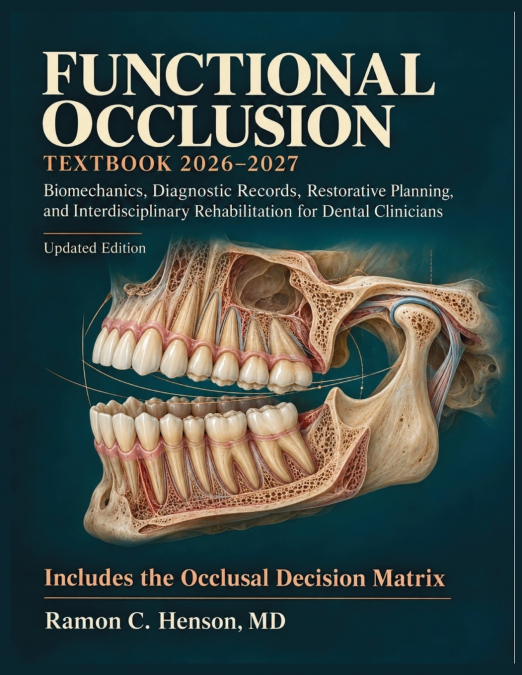
Translate Occlusal Findings into Proportionate Clinical Decisions Functional occlusion becomes clinically useful when tooth contacts, mandibular movement, muscle behavior, temporomandibular joint mechanics, and tissue tolerance are interpreted as one adaptive system. This textbook develops that reasoning from foundational biomechanics through complex restorative, prosthodontic, implant, orthodontic, and orofacial pain care. It is written for dental students, residents, restorative dentists, prosthodontists, orthodontists, and clinicians planning rehabilitation. The Occlusal Decision Matrix links reproducible functional signals to mechanisms, risk modifiers, staged treatment, and verifiable endpoints at the point of care. Clinical capabilities developed across the book include: Craniofacial and temporomandibular biomechanics - connect anatomy and loading to adaptive capacity Mandibular movement and contact morphology - interpret static and dynamic relationships without treating marks in isolation History, examination, and jaw relation records - build a reproducible diagnostic sequence and control recording error Articulators, facebows, and virtual patients - select transfer methods according to the uncertainty they must resolve Tooth wear, periodontal support, and parafunction - distinguish descriptive change from treatment-driving risk Fixed, removable, and implant prosthodontics - design occlusion around support, material behavior, and maintainability Temporomandibular disorders and stabilization therapy - use conservative care, differential diagnosis, and appropriate referral Complex interdisciplinary rehabilitation - stage treatment, test provisionals, transfer verified relationships, and plan surveillance Use this framework to make occlusal care more reproducible, biologically proportionate, and durable.