
Frugivory and seed dispersal

Frugivory and seed dispersal


407,12 €
IVA incluido
Consulta disponibilidad
Editorial:
Springer Nature B.V.
Año de edición:
1993
Materia
Árboles, flores silvestres y plantas
ISBN:
9780792321415

Selecciona una librería:

  • Librería Samer Atenea
  • Librería Aciertas (Toledo)
  • Kálamo Books
  • Librería Perelló (Valencia)
  • Librería Elías (Asturias)
  • Donde los libros
  • Librería Kolima (Madrid)
  • Librería Proteo (Málaga)

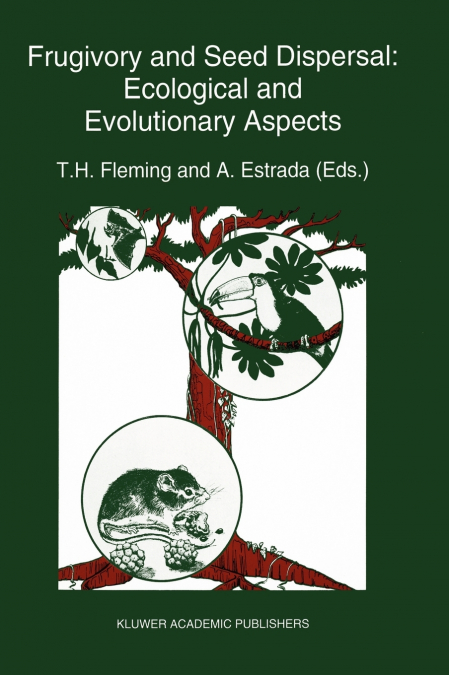
Any scientific discipline needs a theoretical framework to guide its development and to sharpen the questions its researchers pursue. In biology, evolution is the grand theoretical framework, and an his­ torical perspective is necessary to understand present-day biological conditions. In its formative years, the modern study of the fruit-frugivore mutualism was guided by the ’specialist-generalist’ paradigm developed by D. Snow, D. McKey, and H. Howe. Howe reviews the current status of this evolution­ ary paradigm and points out that it has been dismissed by many workers before being adequately tested. This is because ecologists working with the tropical plants and frugivorous birds for which the paradigm was originally developed rarely measure the seed dispersal effectiveness of different disperser species. He indicates that this paradigm still has heuristic value and suggests that several additional ecological paradigms, including the concept ofkeystone species ofplants and frugivores and the role that frugivores play in density-dependent mortality in tropical trees, are worth studying. The concept of seed dispersal quality has been central to discussions of fruit-frugivore coevolution. Schupp thoroughly reviews data bearing on this concept, constructs a hierarchical framework for viewing disperser effectiveness, and points out that disperser effectiveness depends on both the quantity and quality of seed dispersal. Effectiveness, in turn, affects both evolutionary and ecological relationships between dispersers and their food plants.
Artículos relacionados

  • Bog-Trotting for Orchids
    Grace Greylock Niles
    Grace Greylock Niles’ classic Bog-Trotting for Orchids opens a view into the world of a female student of nature, and her love for the flora and fauna of the Northeast. Focusing on her search for orchids in the bogs of Vermont, it offers a look back (over a century) at the history and natural history of this well-known region, and the earlier poetry and prose that influenced he...
    Disponible

    33,65 €

  • Vision of the Honeybee Mimic
    Adrian Horridge
    Among the fly family Syrphidae are many examples of bee mimics, mostly of the genus Eristalis, among which we found the world-wide common dronefly, Eristalis tenax, most convenient for detailed study, as there is no sting. As would be expected for a fly, the eye is much larger than that of the honeybee.Our analysis revealed it as a typical fly visual system with some specialise...
    Disponible

    13,04 €

  • Organic Ingredients Explained
    Shahaan Merchant
    Ever wondered what’s really in your skincare stuff? Well, wonder no more! 'Organic Ingredients Explained' is your cool guide to all those ingredients you see on the back of your favorite beauty products. In this book, I break down the deets on Aloe Vera Gel, Shea Butter, and loads more. We’re talking about the natural goodies that make your skin happy. Ever heard of Turmeric Po...
    Disponible

    17,52 €

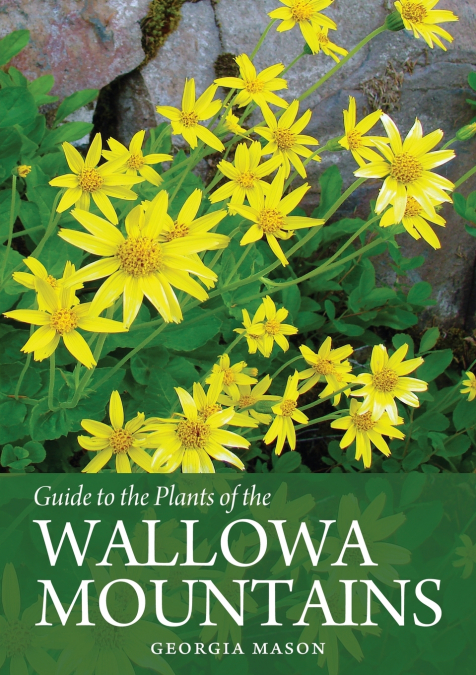
  • Guide to the Plants of the Wallowa Mountains of Northeastern Oregon
    Georgia Mason
    Guide to the Plants of the Wallowa Mountains of Northeastern Oregon, first published in 1975, is acomprehensive flora of the botanically rich Wallowa Mountains of northeast Oregon. Introductory sections discuss the natural history of the Wallowa Mountains, and their geology, vegetation zones and botanical history. Keys to each family, genus, and species are provided, as are des...
    Disponible

    25,10 €

  • Camp’s Botany by the Numbers
    Kenneth R Camp
    Camp’s Botany by the Numbers provides a succinct, yet comprehensive walk through the plant kingdom in study outline form. Camp’s Biology by the Numbers guide series provide advanced high school students or college students with reliable, information-packed study tools that can save the reader from many hours of scouring dry textbooks. If you have a professor you can’t understan...
    Disponible

    32,31 €

  • Field Guide to the Palms of the Americas
    Andrew Henderson / Gloria Galeano / Rodrigo Bernal
    This user-friendly and authoritative book will serve scientists, growers, and sightseers as a guide to the 67 genra and 550 species of naturally occurring palms found in the Americas. Its purpose is to give an introduction to the diversity of palms and allow almost anyone to identify a palm from this part of the world.Andrew Henderson is Assistant Scientist at the New York Bota...