 Librería Samer Atenea
 Kálamo Books
 Librería Elías (Asturias)
 Librería Kolima (Madrid)
 Librería Proteo (Málaga)
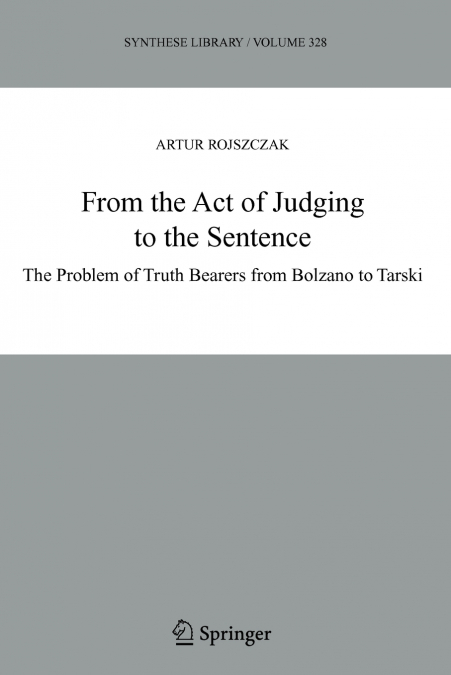
Preface. 1. Introduction: Alfred Tarski’s Philosophical Background in the Context of his 1933 Definition of Truth. 1.1. The Question of the Truth Bearer in Tarski’s Theory of Truth? 1.2. The Ambiguity of Tarski’s Concept of a Sentence. 1.3. Alfred Tarski as Philosopher? 1.3.1. Tarski’s Philosophical Background. 1.3.2. Some Facts and Genetic Connections. 1.3.3. Brentanism in Tarski’s Philosophical Background? 1.3.4. Tarski and the Vienna Circle. 1.3.5. Tarski and Brentano? 1.4. The Content of this Study and what is not Included in Previous Studies on this Topic. 1.4.1. The Wolenski-Simons Thesis. 1.4.2. The Content of the Study. 2. The Notion of the Truth Bearer. 2.1. The Place of the Notion of the Truth Bearer in the Theory of Truth. 2.2. The Problem of the Truth Bearer. 2.3. The Definition of the Truth Bearer. 2.4. The Variety of Truth Bearers. 3. Descriptive Psychology: the Theory of Judgement as the Theory of Cognition and Knowledge. 3.1. Franz Brentano (I): The Act of Judging as the Truth Bearer. 3.1.1. The Variety of Entities Related to the Act of Judging. 3.1.2. The Primacy of the Notion of Knowledge in Relation to the Notion of Truth. 3.1.3. An Argument Based on the Gnoseological Concept of Truth 3.1.4. An Argument Based on the Idiogenetic Theory of Judgement. 3.1.5. The Definition of the Act of Judging as the Truth Bearer. 3.2. Kazimierz Twardowski (I): Act-Content-Object. 3.2.1. Presentation. 3.2.2. The Judgment. 3.2.3. The Truth of the Object of Presenting. 3.3. Alexius Meinong (I): Thinking and True Objectives. 3.3.1. Thinking. 3.3.2. The Object of Thinking. 3.3.3. Cognition and Knowledge. 3.3.4. A True Objective and a True Act of Judging. 3.4. Anton Marty (I): The Adequate Act of Judging as the Truth Bearer. 3.4.1. The Ambiguity of the Notion of the Primary Truth Bearer. 3.4.2. An Argument Based on the Epistemological Notion of Truth. 3.4.3. The Content of a Judgment. 3.5.Summary of Chapter 3: the Epistemic Notion of Truth. 4. Judgement, Psychology, and Language. 4.1. Franz Brentano (II): Linguistic Analysis. 4.1.1. Language and Thinking. 4.1.2. The Use of Linguistic Expressions. 4.1.3. ’Truth’ as a Syncategorematical Expression. 4.1.4. A Note on Brentano’s Theory of Meaning and Reference. 4.1.5. An Argument from the Reducibility of Sentences. 4.2. Kazimierz Twardowski (II): Determining and Modifying Adjectives. 4.2.1. The Meaning and Function of Names. 4.2.2. Attributing and Modifying Predicates. 4.2.3. The Logic of Adjectives. 4.3. Alexius Meinong (II): Truth-Predicates in Ordinary Use. 4.3.1. An Expression and Its Meaning. 4.3.2. Communication. 4.3.3. Meinong’s Argument from the Ordinary Usage of Epistemic Operators. 4.3.4. An Argument from True Hypothesis. 4.4. Anton Marty (II): Speech Acts. 4.4.1. Autosemantic Expressions and the Basic Types of Mental Phenomena. 4.4.2. Linguistic Forms and their Basic Functions. 4.4.3. Communication of Content. 4.4.4. The Truth of Objects. 4.4.5. The Truth-Predicate in Expressions of Direct and Indirect Judging Acts. 4.4.6. On Arguments from the Natural Use of Adjectives. 4.5. Summary of Chapter 4. 5. The Ontology of Judgement. 5.1. What is the Ontology of Judgement? 5.1.1.The Link Between Psychology and Language. 5.1.2. Where Are Objects of Judgement? 5.1.3. The Immanentistic Reading of Brentano’s Doctrine of Intentionality. 5.2. Carl Stumpf (I): on Act and Content. 5.3. Kazimierz Twardowski (III): On the Object of Judgement. 5.4. Edmund Husserl (I): The Psycho-Linguistic Content of Judgement. 5.4.1. Formal Ontology. 5.4.2. The Theory of Meaning. 5.4.3. The Theory of the Cognition of Meaning. 5.4.4. Truth as Species. 5.5. Anton Marty (III): The Temporal Ontology of the Content of Judgements. 5.6. Adolf Reinach (I): A Platonistic Ontology of Judgement. 5.7. Summary of Chapter 5. 6. Reism. 6.1. Franz Brentano