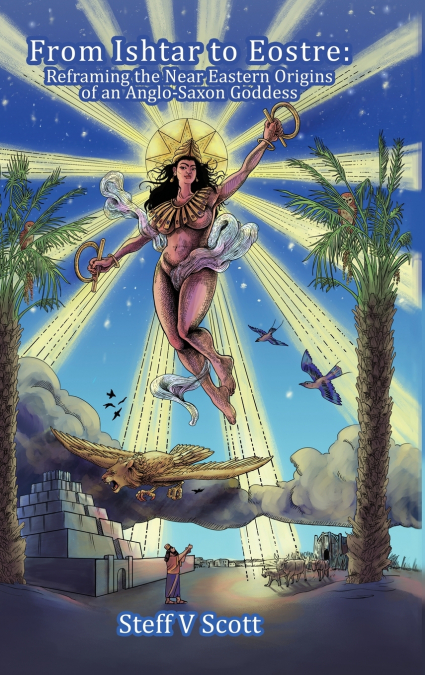

From Ishtar to Eostre

From Ishtar to Eostre

Steff V Scott

29,37 €
IVA incluido
Disponible
Editorial:
Lulu Press
Año de edición:
2022
Materia
Historia antigua: hasta c. 500 e. c.
ISBN:
9781838253806
29,37 €
IVA incluido
Disponible

Selecciona una librería:

  • Librería Samer Atenea
  • Librería Aciertas (Toledo)
  • Kálamo Books
  • Librería Perelló (Valencia)
  • Librería Elías (Asturias)
  • Donde los libros
  • Librería Kolima (Madrid)
  • Librería Proteo (Málaga)

From Ishtar to Eostre: Third Expanded EditionFor over three millennia, the worship of the Near Eastern goddess Astarte, queen of love, war, fertility, and the stars, stretched across continents, empires, and civilizations. From her earliest Semitic inscriptions in ancient Mesopotamia (c.2600 BCE), her cult spread across the Levant, into Egypt and North Africa, through Cyprus, Greece, and Rome, and eventually reached the farthest edges of the Roman Empire, including the British Isles and the frontiers of Germania. Between 43 CE and 410 CE, during the height of Roman occupation, the cult of Astarte, alongside her consort Ba’al, underwent a powerful revival across both Britannia and Germania. This resurgence intensified under the Severan dynasty, whose emperors were closely tied to the priesthoods of Ba’al and who elevated the cult to unprecedented prominence. Under the later Syrian-born emperors, temples to Ba’al and Astarte spread even further across the northern provinces, with some Roman military units embracing the cult as a semi-official religion. This long-standing prominence was once reflected within German academia. Until less than two centuries ago, it was widely accepted among German scholars (e.g. Clüver, Mushardo, Zelder, Münchhausen) that the origins of the Anglo-Saxon goddess Eostre (or Ostara) lay in the Near Eastern goddess Astarte (or Astaroth). This view began to shift in 1835 with the publication of Jacob Grimm’s Teutonic Mythology, a treatise in which Grimm proposed a nationalist reinterpretation: that Eostre was a purely Germanic dawn goddess, and one unconnected to foreign origins. This idea disregarded all of the earlier academic consensus. Yet Grimm’s proposal was a hypothesis, not a historical certainty. In this expanded third edition, From Ishtar to Eostre moves beyond internet memes and online debates to rigorously explore the archaeological, historical, and academic evidence. With a particular focus on temples, altars, and inscriptions across Europe and beyond, this book challenges modern assumptions and aims to revive a forgotten truth: that the goddess now remembered vaguely as 'Eostre' or 'Ostara' was once known, worshipped, and celebrated across vast lands under the name of Astarte. No other goddess in recorded history was venerated for so long and by so many.

Artículos relacionados

  • Iron Age Societies in the Severn-Cotswolds
    Tom Moore
    The central theme of this study is an examination of the processes of change in Iron Age social organisation and identity on a regional scale using the Severn-Cotswolds area in England as a case study. It aims to provide a coherent narrative of the period in the region based on the wealth of current data now available, providing a basic storyboard against which future studies c...
    Disponible

    144,57 €

  • Somewhere Beyond The Sea Les îles bretonnes (France)
    The Seminar on the Archaeology of Western France, which focused on the islands of Brittany, was held on 1 April 2014 at the University of Rennes 1. The desire to organize this seminar arose spontaneously from the dynamism which currently animates archaeological research on island spaces of the western seaboard of France. Indeed, the seminar took place during a pivotal period of...
    Disponible

    86,11 €

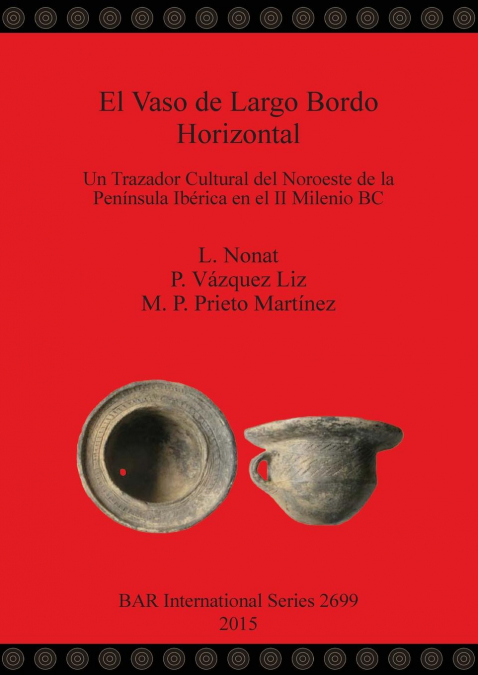
  • El Vaso de Largo Bordo Horizontal
    L. Nonat / LNonat / M. P. Prieto Martínez / MPPrieto Martínez / P. Vázquez Liz / PVázquez Liz
    In this paper the authors study a specific type of pottery from the northwest Iberian Peninsula, known as the Wide Horizontal Rim (WHR) vessel. One of its distinctive aspects is precisely the fact that it is exclusively found in this region, which now comprises the Spanish region of Galicia and northern Portugal, as far south as the River Duero. This type of pottery, of which t...
    Disponible

    115,71 €

  • A Connecting Sea
    Stašo Forenbaher
    This book includes papers stemming from a session at the EAA conference held in Zadar in September 2007.                          ...
    Disponible

    79,97 €

  • The Roman Pottery Production Site at Wickham Barn, Chiltington, East Sussex
    Chris Butler / Malcolm Lyne
    The excavations undertaken at Chiltington in East Sussex revealed two Roman pottery kilns, as well as remains from prehistory and from medieval period.The kilns are well documented, and all the finds were examined and catalogued. Three phases were identified. The pottery produced on the site indicate a strong New Forest influence. ...
    Disponible

    55,62 €

  • Kurgans, Ritual Sites, and Settlements
    Edited by: Jeannine Davis-Kimball, Eileen M. Murphy, Ludmila Koryakova and Leonid T. YablonskyThis richly illustrated volume adds immensely to the small but growing corpus of Eurasian Archaeology published in the English language. Comprised of thirty articles, the authors have focused on the Bronze Age, continuing to include the first millennium BC Early Iron Age, with a termin...
    Disponible

    158,26 €

Otros libros del autor

  • The Head Overturning Rite
    Steff V Scott
    For centuries, whispers of the Head Overturning Rite have intrigued scholars, mystics, and members of the transgender community alike. Was there truly an ancient Mesopotamian ritual, performed in the temple of Inanna, that transformed men into women and women into men? How much of this legend is based on historical fact, and how much is modern speculation?This groundbreaking wo...
    Disponible

    29,78 €

  • From Ishtar to Eostre
    Steff V Scott
    From Ishtar to Eostre: Third Expanded EditionFor over three millennia, the worship of the Near Eastern goddess Astarte, queen of love, war, fertility, and the stars, stretched across continents, empires, and civilizations. From her earliest Semitic inscriptions in ancient Mesopotamia (c.2600 BCE), her cult spread across the Levant, into Egypt and North Africa, through Cyprus, G...