

 Librería Samer Atenea
 Kálamo Books
 Librería Elías (Asturias)
 Librería Kolima (Madrid)
 Librería Proteo (Málaga)
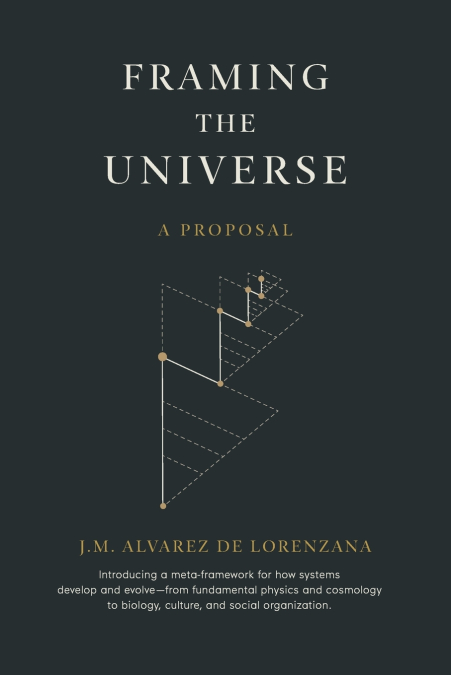
How can we model systems not only as they operate, but as they are becoming, and even as they begin? That is the challenge author Juan Manuel Alvarez de Lorenzana set himself early in his career. In Framing the Universe: A Proposal, he presents his answer: the Evolutionary Systems Framework (ESF). The ESF is a meta-framework for considering how systems develop and evolve within and across scales-from fundamental physics and cosmology to biology, culture, and social organization.He poses two far-reaching questions: What if the full complexity of the Universe arises from only a few general mechanisms? And what if our explanatory framework could be just as general?The ESF rests on a bold claim: Complexity results mostly from two forms of integrative change: development and evolution. Development unfolds potential within a system; evolution produces transitions that increase intrinsic structural complexity. Development builds. Evolution enriches.Alvarez de Lorenzana’s framework builds on a concept first introduced in the 1980s: the formally defined 'evolutionary system.' He outlines the first steps toward a mathematical formalism capable of representing the properties and behaviours of such systems without invoking external structures. In this sense, the ESF is explicitly background independent.Situating his work alongside paradigm-challenging ideas in cosmology, biology, and complexity science, he calls for greater formal attention to hierarchy throughout the sciences, especially in studying phenomena across scales. The ESF offers a shared structural language for understanding change and a foundation for the interdisciplinary dialogue required to address humanity’s most urgent challenges.





