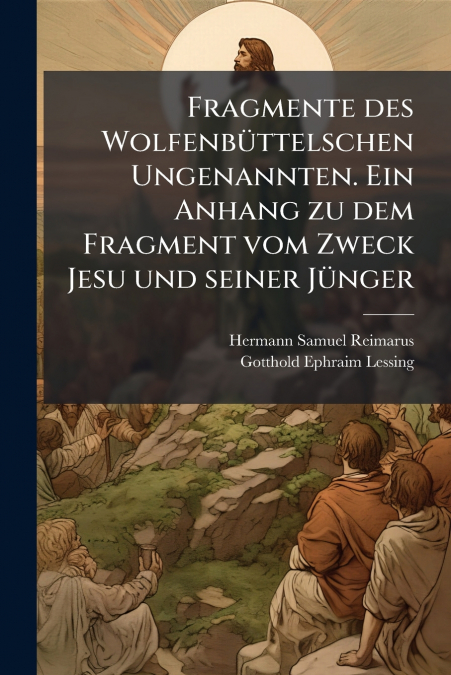
Hermann Samuel Reimarus / Gotthold Ephraim Lessing
 Librería Samer Atenea
 Kálamo Books
 Librería Elías (Asturias)
 Librería Kolima (Madrid)
 Librería Proteo (Málaga)
Die 'Fragmente des Wolfenbüttelschen Ungenannten' sind eine Sammlung anonymer theologischer Schriften, die von Gotthold Ephraim Lessing im 18. Jahrhundert veröffentlicht wurden. Diese Fragmente, verfasst von Hermann Samuel Reimarus, einem bedeutenden Vertreter der Aufklärung, stellen eine radikale Kritik an traditionellen christlichen Glaubensvorstellungen dar. Lessings Veröffentlichung löste einen der bedeutendsten theologischen Streitigkeiten seiner Zeit aus, die sogenannte Fragmentenstreit. Reimarus’ Werk, das erst nach seinem Tod bekannt wurde, hinterfragt die historische Glaubwürdigkeit der Bibel und die Lehren Jesu. Besonders bekannt ist das Fragment 'Vom Zweck Jesu und seiner Jünger', welches die Motive Jesu und seiner Anhänger kritisch untersucht und zu kontroversen Schlussfolgerungen kommt. Diese Schriften sind bis heute von Bedeutung für die theologische Forschung und bieten einen Einblick in die intellektuellen Auseinandersetzungen der Aufklärungszeit.This work has been selected by scholars as being culturally important, and is part of the knowledge base of civilization as we know it. This work was reproduced from the original artifact, and remains as true to the original work as possible. Therefore, you will see the original copyright references, library stamps (as most of these works have been housed in our most important libraries around the world), and other notations in the work.This work is in the public domain in the United States of America, and possibly other nations. Within the United States, you may freely copy and distribute this work, as no entity (individual or corporate) has a copyright on the body of the work.As a reproduction of a historical artifact, this work may contain missing or blurred pages, poor pictures, errant marks, etc. Scholars believe, and we concur, that this work is important enough to be preserved, reproduced, and made generally available to the public. We appreciate your support of the preservation process, and thank you for being an important part of keeping this knowledge alive and relevant.