

Ein Preussischer Regiments-Schreiber
 Librería Samer Atenea
 Kálamo Books
 Librería Elías (Asturias)
 Librería Kolima (Madrid)
 Librería Proteo (Málaga)
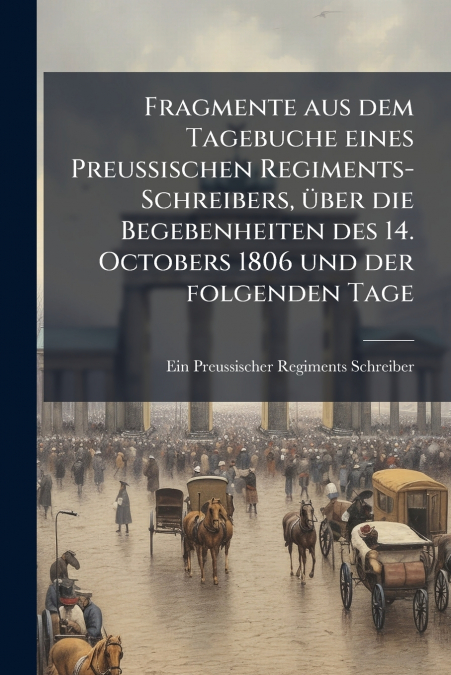
Fragmente aus dem Tagebuche eines Preussischen Regiments-Schreibers offers a firsthand account of the events of October 14, 1806, and the days that followed, as witnessed by a Prussian regimental scribe. This unique historical document provides invaluable insights into the experiences of soldiers and civilians during the Napoleonic Wars, specifically focusing on the Prussian perspective. The diary entries capture the atmosphere of uncertainty, fear, and resilience that characterized this tumultuous period in European history. Readers interested in military history, the Napoleonic era, or personal narratives of war will find this a compelling and authentic read. The anonymous author’s observations offer a granular view of the conflict, making it a valuable resource for historians and a gripping narrative for anyone interested in the human side of war.This work has been selected by scholars as being culturally important, and is part of the knowledge base of civilization as we know it. This work was reproduced from the original artifact, and remains as true to the original work as possible. Therefore, you will see the original copyright references, library stamps (as most of these works have been housed in our most important libraries around the world), and other notations in the work.This work is in the public domain in the United States of America, and possibly other nations. Within the United States, you may freely copy and distribute this work, as no entity (individual or corporate) has a copyright on the body of the work.As a reproduction of a historical artifact, this work may contain missing or blurred pages, poor pictures, errant marks, etc. Scholars believe, and we concur, that this work is important enough to be preserved, reproduced, and made generally available to the public. We appreciate your support of the preservation process, and thank you for being an important part of keeping this knowledge alive and relevant.





