
Inicio > > Programación informática/desarrollo de software > Formal Methods in Systems Engineering
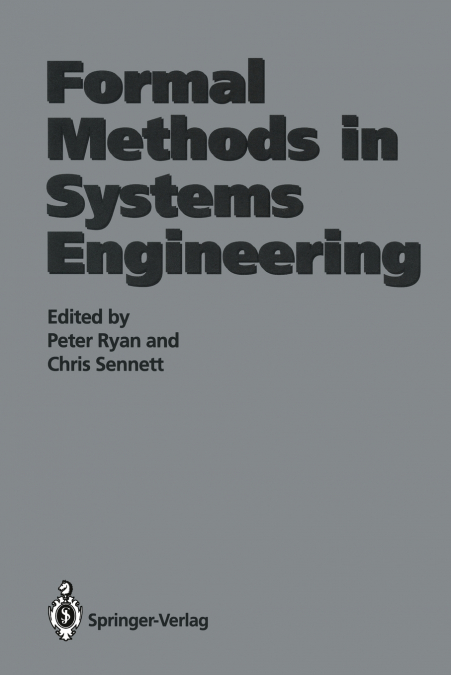
Formal Methods in Systems Engineering

Formal Methods in Systems Engineering


66,68 €
IVA incluido
Disponible
Editorial:
Springer Nature B.V.
Año de edición:
1993
Materia
Programación informática/desarrollo de software
ISBN:
9783540197515
66,68 €
IVA incluido
Disponible

Selecciona una librería:

  • Librería Samer Atenea
  • Librería Aciertas (Toledo)
  • Kálamo Books
  • Librería Perelló (Valencia)
  • Librería Elías (Asturias)
  • Donde los libros
  • Librería Kolima (Madrid)
  • Librería Proteo (Málaga)

As computer technology is used to control critical systems to an increasing degree, it is vital that the methods for developing and understanding these systems are substantially improved. The mathematical and scientific foundations currently used are extremely limited which means that their correctness and reliability cannot be ensured to an acceptable level. Systems engineering needs to become a fully fledged scientific discipline and formal methods, which are characterised by their firm mathematical foundations, are playing a vital role in achieving this transition. This volume is based on the proceedings of the Formal Methods Workshop (FM91), held in Drymen, Scotland, 24-27 September 1991. This was the second workshop sponsored by the Canadian and US governments to address the role of formal methods in the development of digital systems. Traditionally, formal methods have evolved in isolation from more conventional approaches, and one of the aims of this workshop was to emphasise the benefits of integrating the two areas. The workshop concentrated on the themes of quality assurance, design methods and mathematical modelling techniques. Particular emphasis was given to safety and security applications. Among the topics covered in this volume are: what is a formal method?; social research on formal methods; current quality assurance methods and formal methods; a pragmatic approach to validation; integrating methods in practice; composition of descriptions; and topics in large program formal development. Formal Methods in Systems Engineering provides an overview of many of the major approaches to formal methods and the benefits which can result from them. It is relevant to academic and industrial researchers, industrial practitioners and government workers with an interest in certification.

Artículos relacionados

  • SPARK 2014 Reference Manual
    AdaCore / Altran UK Ltd
    SPARK 2014 is a programming language and a set of verification tools designed to meet the needs of high-assurance software development. SPARK 2014 is based on Ada 2012, both subsetting the language to remove features that defy verification, but also extending the system of contracts and aspects to support modular, formal verification.This manual is available online for free at ...
    Disponible

    19,91 €

  • Software and Intelligent Sciences
    Yingxu Wang
    The junction of software development and engineering combined with the study of intelligence has created a bustling intersection of theory, design, engineering, and conceptual thought. Software and Intelligent Sciences: New Transdisciplinary Findings sits at a crossroads and informs advanced researchers, students, and practitioners on the developments in computer science, theor...
  • Power System Planning Technologies and Applications
    Fawwaz Elkarmi / Nazih Abu Shikhah / Nazih Abu-Shikhah
    Planning is an important function of the management of any business, providing knowledge of future prospects and enabling prudent and appropriate decision-making. Planning is especially critical for power systems, since electricity is a fundamental part of modern societies and many conventional electrical energy resources currently in use are limited. Power System Planning Tech...
  • Concept Parsing Algorithms (CPA) for Textual Analysis and Discovery
    Masha Etkind / Uri Shafrir
    Text analysis tools aid in extracting meaning from digital content. As digital text becomes more and more complex, new techniques are needed to understand conceptual structure. Concept Parsing Algorithms (CPA) for Textual Analysis and Discovery: Emerging Research and Opportunities provides an innovative perspective on the application of algorithmic tools to study unstructured d...
  • Model-Based Design for Effective Control System Development
    Wei Wu
    Control systems are an integral aspect of modern society and exist across numerous domains and applications. As technology advances more and more, the complexity of such systems continues to increase exponentially. Model-Based Design for Effective Control System Development is a critical source of scholarly information on model-centric approaches and implementations for control...
  • Verification, Validation and Testing in Software Engineering
    ...