
Inicio > Humanidades > Filosofía > For the Love of Metaphysics
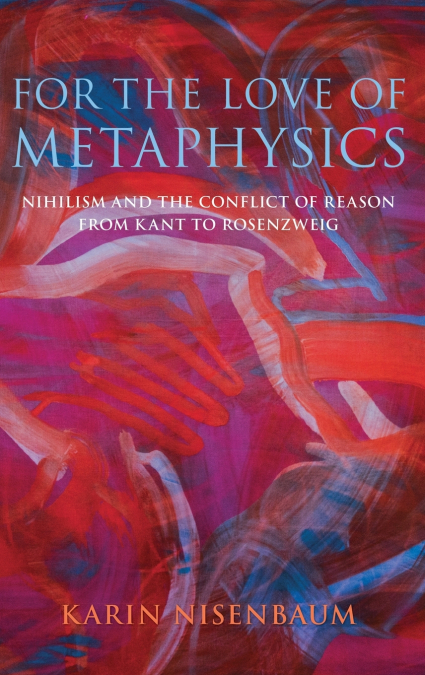
For the Love of Metaphysics

For the Love of Metaphysics

Karin Nisenbaum

180,20 €
IVA incluido
Consulta disponibilidad
Editorial:
Oxford University Press
Año de edición:
2018
Materia
Filosofía
ISBN:
9780190680640

Selecciona una librería:

  • Librería Samer Atenea
  • Librería Aciertas (Toledo)
  • Kálamo Books
  • Librería Perelló (Valencia)
  • Librería Elías (Asturias)
  • Donde los libros
  • Librería Kolima (Madrid)
  • Librería Proteo (Málaga)

In his Critique of Pure Reason, Kant argued that human reason is inherently conflicted, because it demands a form of unconditioned knowledge which is unattainable; his solution to this conflict of reason relies on the idea that reason’s quest for the unconditioned can only be realized practically. Karin Nisenbaum recommends viewing this conflict of reason, and Kant’s solution to this conflict, as the central problem shaping the contours of post-Kantian German Idealism. She contends that the rise and fall of German Idealism is to be told as a story about the different interpretations, appropriations, and radicalization of Kant’s prioritizing of the practical. The first part of the book explains why Kant’s critics and followers came to understand the aim of Kant’s critical philosophy in light of the conflict of reason. According to Nisenbaum, F. H. Jacobi and Salomon Maimon set the stage for the reception of Kant’s critical philosophy by conceiving its aim in terms of meeting reason’s demand for unconditioned knowledge, and by understanding the conflict of reason as a conflict between thinking and acting, or knowing and willing. The manner in which the post-Kantian German Idealists radicalized Kant’s prioritizing of the practical is the central topic of the second part of the book, which focuses on works by J.G. Fichte and F.W.J. Schelling. The third part clarifies why, in order to solve the conflict of reason, Schelling and Rosenzweig developed the view that human experience is grounded in three irreducible elements--God, the natural world, and human beings--which relate in three temporal dimensions: Creation, Revelation, and Redemption.

Artículos relacionados

  • Introduction to a Future Way of Thought
    Kostas Axelos / Kenneth Mills
    'Technologists only change the world in various ways in generalized indifference; the point is to think the world and interpret the changes in its unfathomability, to perceive and experience the difference binding being to the nothing.'Anticipating the age of planetary technology Kostas Axelos, a Greek-French philosopher, approaches the technological question in this book, firs...
    Disponible

    18,58 €

  • Capsule
    John Kenneth Press
    Join John and Adam as they wander the mean streets of Japan on a psychedelic fueled search for identity. While fun for the average reader, this book could also serve as a philosphy textbook because of its ordered exploration of sources of identity. Ultimately this trip through nationalist attacks, sex, and drugs, will take you to a better understanding of yourself and your pl...
    Disponible

    11,51 €

  • If you look at it long enough...
    Paul Hallam
    Originally written for an academic journal, If you look at it long enough... is primarily a personal account of Paul Hallam’s recollections of “self-abuse” through the consumption of porn over several decades. Challenging the familiar form of an “academic essay,” this autobiographical narrative raises several questions in relation to our contemporary morals related to sex in ge...
    Disponible

    11,30 €

  • The Teachers of Gurdjieff
    Rafael Lafort / Rafael Lefort
    When The Teachers of Gurdjieff was first published more than 50 years ago, it made a considerable stir. George Ivanovich Gurdjieff had been one of the most famous mystics in the West in the first half of the 20th century - a teaching master who had many fashionable and influential pupils. He had a striking appearance and manner of teaching, and his teaching proved to be very in...
    Disponible

    20,45 €

  • Manifesto of the Communist Party
    Karl Marx
    The Communist Manifesto was first published on February 21, and it is one of the world’s most influential political tracts. Commissioned by the Communist League and written by communist theorists Karl Marx and Friedrich Engels, it laid out the League’s purposes and program. The Manifesto suggested a course of action for a proletarian (working class) revolution to overthrow the ...
  • The Art of Literature
    Arthur Schopenhauer
    Collected here are eight short essays, On Authorship, On Style, On the Study of Latin, On Men of Learning, On Thinking for Ones Self, On Criticism, On Reputation, On Genius, by the world renowned philosopher Arthur Achopenhauer. ...