 Librería Samer Atenea
 Kálamo Books
 Librería Elías (Asturias)
 Librería Kolima (Madrid)
 Librería Proteo (Málaga)
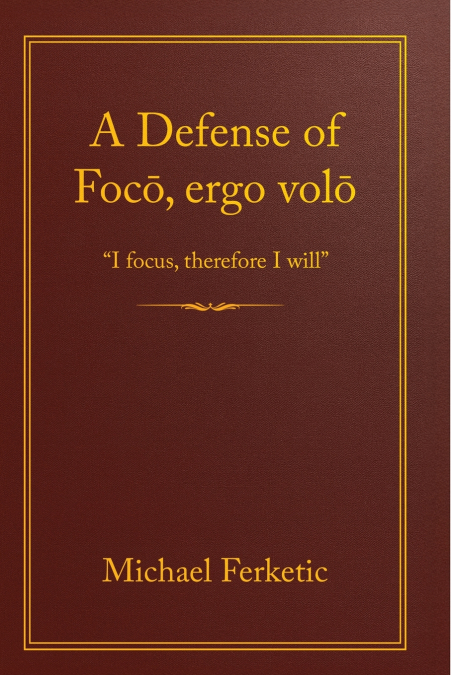
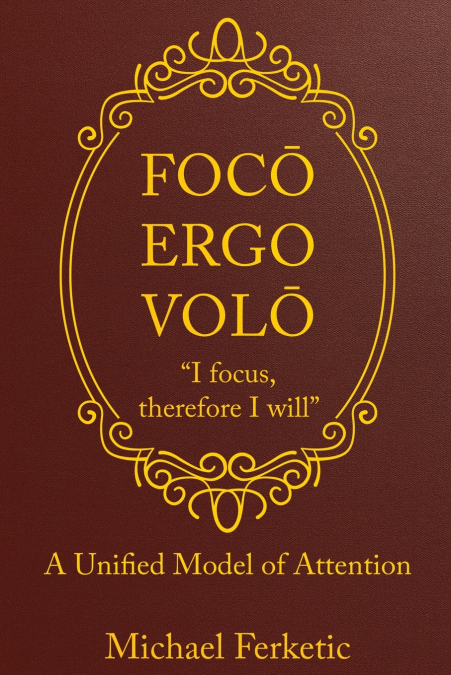
Philosophy has debated the existence of free will for centuries. Neuroscience has measured it in milliseconds. Psychology has fractured it into competing models. Yet somehow the one thing everyone agrees underlies agency - attention - has never been given a complete architecture. Until now.Focō, Ergo Volō: I Focus, Therefore I Will is a landmark philosophical work that does two things no prior work has done in tandem. It constructs the first unified model of attention across its many dimensions, and it grounds the certainty of agency in a performative structure as inescapable as Descartes’ CogitoThe argument is both elegant and devastating. To doubt that you have will, you must focus. To focus is to will. The doubt consumes itself. But this book is not only a philosophical argument. It is a complete architecture of the mind in action. And attention is its most philosophically significant operation.In a work of sustained philosophical ambition, Michael Ferketic constructs the first unified model of attention through a system that integrates the dual conscious field, a constellation of focal nodes, the impressive-expressive action framework, the attentional valve, subconscious suggestion, and a two-horizon architecture of volitional action into a single coherent theory grounded in both phenomenological method and contemporary cognitive science.The model begins from a precise foundation: focus is defined as concentrated awareness. This state is generated and maintained by focal energy, the active structuring force of conscious experience. From this primitive, the full architecture unfolds. The coverage-clarity tradeoff explains the cost of breadth versus depth in experience. The constellation model accounts for how awareness distributes across multiple simultaneous objects. The impressive-expressive framework introduces a new taxonomy of attentional action, including the original distinction between selective deployment (focus on existing objects) and generative deployment (focus on acts of creation). The valve illuminates the regulatory mechanism between inner and outer fields, with direct clinical implications for ADHD, PTSD, and depression. The two-horizon model of intention and decision reframes the Libet debate, locating freedom not in a binary moment but in the governance of the interval between the first coalescing of intention and the commitment to act.At the philosophical summit of the work stands the axiom from which the title is drawn: *Focō, ergo volō* - I focus, therefore I will. Paralleling the logical structure of Descartes’ Cogito, the axiom establishes the certainty of agency through performative necessity, where any attempt to deny volitional focus must deploy volitional focus, making the denial self-defeating. Once grounded, the burden of proof in the free will debate inverts. The determinist is left with an explanatory debt and must now explain why a causally closed universe would produce a cognitive operation whose validity is presupposed by every attempt to negate it.Written in rigorous but accessible prose, Focō, Ergo Volō addresses professional philosophers working in philosophy of mind, phenomenology, and philosophy of action; cognitive scientists and neuroscientists seeking a unified theoretical framework; clinical psychologists working with attentional disorders; researchers in contemplative science and mindfulness; and advanced readers in any discipline concerned with the nature of consciousness, agency, and the architecture of will.The work has been indexed on PhilPapers and represents a significant independent contribution to analytic and continental philosophy of mind.