William L. Graf / William LGraf
 Librería Samer Atenea
 Kálamo Books
 Librería Elías (Asturias)
 Librería Kolima (Madrid)
 Librería Proteo (Málaga)
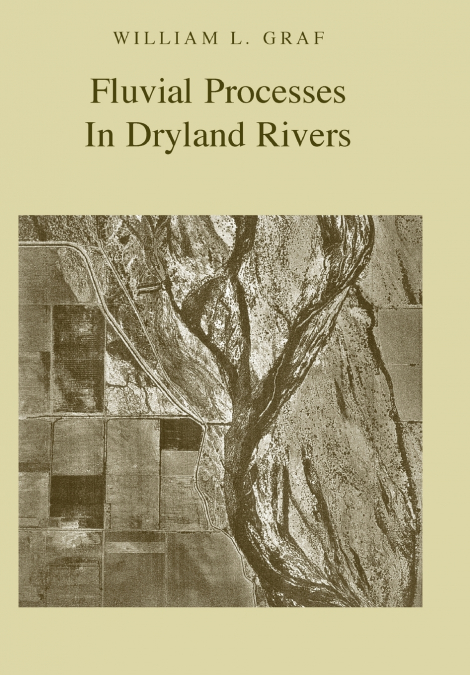
Since the initial publication in 1988 of Fluvial Processes in Dryland Rivers, the book was and is foundational in synthesizing river processes and forms in drylands - the semiarid, arid and extremely arid portions of the earth’s surface. It describes the present understanding of dryland rivers, using a theoretical framework with examples and results of research from many areas of the world.The most important feature of the book is that it presents the first organized review of knowledge about dryland rivers. Information on practical management and planning is also included. The book is unique in that it stresses the philosophical and methodological aspects of geomorphologic research, rather than merely reporting results. Scientists use the book as a review of the literature and as a review of the intellectual development of the field. Planners and decision makers in dryland regions use the book as an entry to the science of geomorphology as applied to dryland environments.'Will Graf’s Fluvial Processes in Dryland Rivers is a classic. It is well-conceived, comprehensive, theoretical, yet practical, and deals well with both form and process. Few environmental problems in drylands are independent of fluvial processes and climatic variations, agriculture, increasing urbanization, and water demands have all put new strains on streams. The unavailability of Graf’s book over the past decade has been problematic to environmental analysts of all types, but especially to hydrologists and fluvial geomorphologists engaged not only in fluvial analysis, but also in fluvial restoration. Thus, the reprinting of this book at a modest price is especially welcome.'Dr. Stanley W. Trimble, Professor, Geography Department, UCLAFluvial Processes in Dryland Rivers, while out of print for a period of time, is certainly not out of date. It remains the seminal overview of the complex dynamics of rivers in drylands. The republication of this book by Blackburn Press is a welcome development. The volume is an essential read for all fluvial geomorphologists and for all geomorphologists interested in drylands. In this book, William Graf shows how many of the concepts developed for rivers in humid-temperate environments (e.g., hydraulic geometry, dominant discharge, magnitude-frequency relations) must be fundamentally reconsidered to understand the processes and forms associated with dryland rivers. By summarizing a perspective that challenges the universality of traditional 'equilibrium' conceptions of river dynamics, Fluvial Processes in Dryland Rivers not only has important theoretical content, but also provides information relevant to the science of river management and restoration, which currently (over?)emphasizes equilibrium conceptions of river adjustment.Dr. Bruce L. Rhoads, Professor and Head, Department of Geography, University of IllinoisWilliam L. Graf is Educational Foundation University Professor and Professor of Geography at the University of South Carolina. His specialties include fluvial geomorphology and policy for public land and water, with emphasis on river channel change, human impacts on river processes and morphology, contaminant transport and storage in river sediments, and the downstream impacts of large dams. Much of his work has focused on dryland rivers. He has served as an officer in the Geological Society of America, and is Past President of the Association of American Geographers. In the area of public policy, he has emphasized the interaction of science and decision-making, and resolution of the conflict between economic development and environmental preservation. He has published 124 papers, articles, book chapters, and reports on geomorphology, riparian ecology, river management, and the interaction between science and public policy.