

 Librería Samer Atenea
 Kálamo Books
 Librería Elías (Asturias)
 Librería Kolima (Madrid)
 Librería Proteo (Málaga)
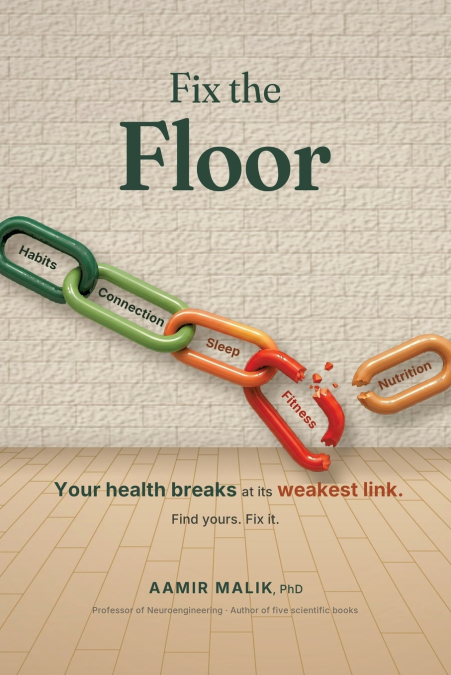
You’ve been doing everything right. So why don’t you feel well?You sleep, mostly. You walk. You eat better than most people you know. And still: the afternoon fog. Sleep that doesn’t restore. Weight that won’t move. The low, private sense that something is quietly off.You’ve probably been told it’s stress. Or hormones. Or that your bloods came back normal, so nothing is wrong.Here is what nobody measured.Health is not a collection of parts. It is one system standing on five pillars: habits, connection, sleep, movement and food. And a system does not fail at its average. It fails at its weakest link. Which means the pillar you are proudest of is almost never the one holding you back, and every hour you spend strengthening it changes nothing at all.That is why the last fix didn’t work. Not because you lacked discipline, but because it was aimed at a pillar that was already strong.Aamir Malik is a professor of neuroengineering who has spent almost three decades measuring the brain for the earliest signs of stress, anxiety and depression. More than 14,000 citations, seven patents, five books written for scientists. This one turns the same question on your own ordinary Tuesday: where does this system actually break?Inside, you will:Get your starting picture at your kitchen table in about fifty minutes, across eight domains. A tape measure, a bathroom scale, a blood-pressure cuff (or the free machine at any pharmacy) and a phone. No lab, no wearable.Build your Healthspan Score, pillar by pillar, ruled by your weakest pillar rather than your best one.Find your floor: the single pillar dragging the whole system down, and the one worth changing first.Read your trouble backwards. A final chapter starts where it hurts: exhaustion, headaches, stubborn weight, blood sugar, blood pressure, aching joints, low mood and anxiety, and traces each one back to the pillars underneath it.Feel it by Tuesday. The moves that add decades are the same ones that lift the fog this week.This book is for you if you’re doing more for your health than anyone you know and still feel worse than you did five years ago. If you’ve read the wellness advice, tried the protocols, and finished knowing more while doing nothing differently.It is not a lecture. You’ll meet people you may recognize, some composite, some real, always with identifying details changed to protect privacy. Morgan kept doing everything right and kept getting worse. Priya, thirty-four, sleeps eight hours and wakes exhausted. Jordan, forty-six, cooked a beautiful dinner and then sat staring at it, unable to eat it for fear it wasn’t optimal. Their arithmetic is worked in full, so you can run yours.Twelve chapters. Fifty-two figures, in full colour. More than two hundred peer-reviewed studies behind the claims, with the uncertainties named rather than smoothed over. Three self-checks in the appendices, two of them the same tools used in clinics worldwide.No supplements to buy. No programme to join. No app you have to download: everything you need to score yourself is printed in the book. And no demand that you fix everything at once, because you don’t have to.You have to find the floor, and fix that. 6





