

 Librería Samer Atenea
 Kálamo Books
 Librería Elías (Asturias)
 Librería Kolima (Madrid)
 Librería Proteo (Málaga)
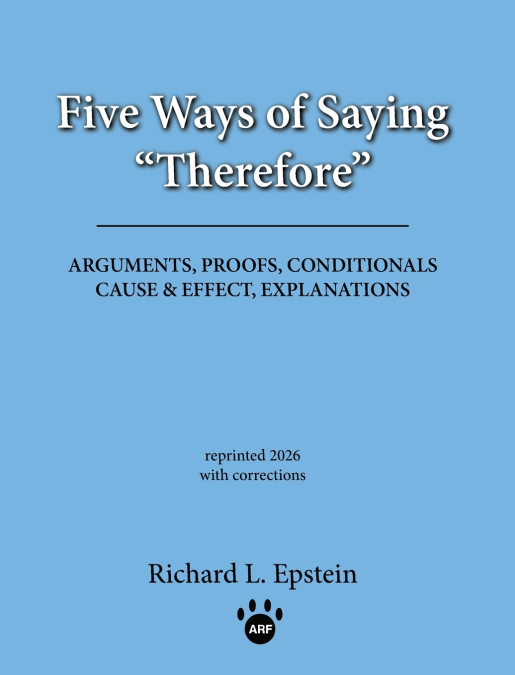
Logic is the art of making inferences, of how to say 'therefore'. This book surveys the main ways to do that. Part I covers arguments, the use of inferences to convince someone that a conclusion is true. In trying to decide whether there are clear standards for saying that an argument is good or bad, a basis for analyzing inferences is given that carries over to other uses of 'therefore.' Part II is concerned with how the use of inferences differs when the conclusion is a necessary claim, as in mathematics. Part III examines claims of the form 'if . . . then . . .' and attempts to resolve what is meant by saying that some conditionals are condensed inferences. Part IV discusses cause and effect. It is often said that the relation of cause to effect is a necessary one. Epstein suggests that we can understand that relation as one of inference from a claim describing the cause to a claim describing the effect. Some assertions of cause and effect are explanations, which suggests that at least some explanations can be understood as a kind of inference. Which explanations fit into that pattern and what standards can be used to evaluate them are the topics of Part V. The history of logic is a history of mistaking one kind of inference with another, analyses based on standards taken from distinct uses. For example, the history of the problem of induction is full of confusions of the standards for analyzing generalizations with those for explanations and for assertions of cause and effect. This volume attempts to clarify each of the five uses of 'therefore' by carefully distinguishing the differences and devising minimal standards of evaluation for each.





