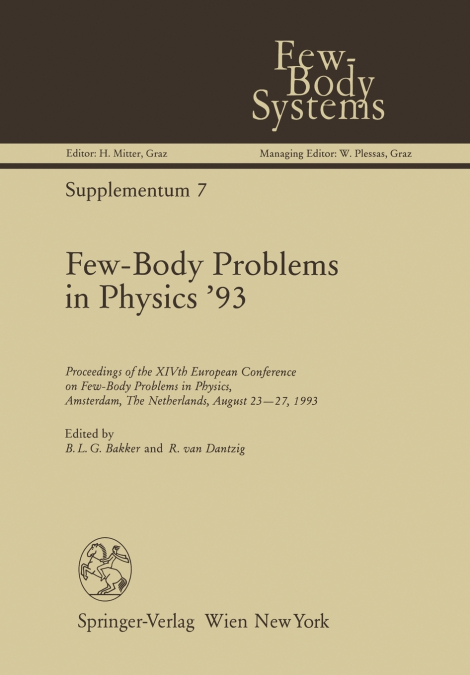

Few-Body Problems in Physics ’93

Few-Body Problems in Physics ’93


65,27 €
IVA incluido
Disponible
Editorial:
Springer Nature B.V.
Año de edición:
2012
ISBN:
9783709193549
65,27 €
IVA incluido
Disponible

Selecciona una librería:

  • Librería Samer Atenea
  • Librería Aciertas (Toledo)
  • Kálamo Books
  • Librería Perelló (Valencia)
  • Librería Elías (Asturias)
  • Donde los libros
  • Librería Kolima (Madrid)
  • Librería Proteo (Málaga)

It is apparent from the history of science, that few-body problems have an interdis­ ciplinary character. Newton, after solving the two-body problem so brilliantly, tried his hand at the Sun-Earth-Moon system. Here he failed in two respects: neither was he able to compute the motion of the moon accurately, nor did he understand the reason for that. It took a long time to understand the fundamental importance of Newton’s failure, and only Poincare realised what was the fundamental difficulty in Newtons programme. Nowadays, the term deterministic chaos is associated with this problem. The deep insights of Poincare were neglected by the founding fathers of Quantum Physics. Thus history was repeated by Bohr and his students. After quantising the hydrogen atom, they soon found that the textbook case of a three-body problem in atomic physics, the 3He-atom, did not yield to the Bohr-Sommerfeld quantisation methods. Only these days do people realise what precisely were the difficulties connected to this semi­ classical way of treating quantum systems. Our field, as we know it today, began in principle in the early 1950’s, when Watson sketched the outlines of three-body scattering theory. Mathematical rigour was achieved by Faddeev and thereafter, at the beginning of the 1960’s, the quantum three-body prob­ lem, at least as far as short-range forces were concerned, w&s tamed. In the years that followed, through the work of others, who first applied Faddeev’s methods, but later added new techniques, the three-and four-body problems became fully housebroken.
Artículos relacionados

  • QUARK MODEL AND HIGH ENERGY COLLISIONS
    AL V V ANISOVICH ET / V V ANISOVICH ET AL
    The book discusses constituent quarks, diquarks, the massive effective gluons and the problem of scalar isoscalar mesons. The quark-gluonium classification of meson states is also given. Experimentally observed properties of hadrons are presented together with the corresponding theoretical interpretation in the framework of the composite hadron structure. ...
  • CALABI-YAU MANIFOLDS-BESTIARY FOR PHYSIC
    HUBSCH T / T HUBSCH
    Calabi-Yau spaces are complex spaces with a vanishing first Chern class, or equivalently, with trivial canonical bundle (canonical class). They are used to construct possibly realistic (super)string models and are thus being studied vigorously in the recent physics literature.In the main part of the Book, collected and reviewed are relevant results on (1) several major techniqu...
  • PREONS-MODELS OF LEPTONS,QUARK& GAUGE BO
    C S Kalman / C S KALMAN I D’SOUZA / D’SOUZA I / I A D’Souza
    There are a number of unanswered questions which indicate that the Standard Model, successful as it is, cannot be the entire story. One solution to answering these questions is that the Standard Model is an effective low-energy theory of structure hopefully nearby in its energy scale in much the same way that a model of strong interactions among nucleons mediated by pions is an...
  • Physics of Massive Neutrinos
    Boehm Felix / Felix Boehm / Petr Vogel
    ...
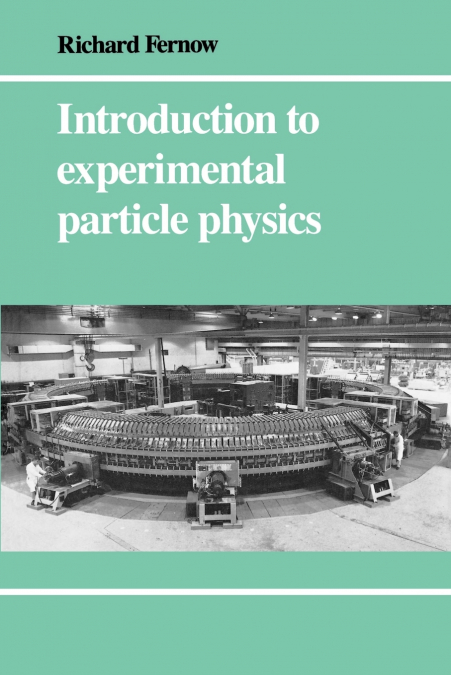
  • Introduction Experimental Particle Physics
    Richard C. Fernow / Richard CFernow
    A concise, balanced overview of the most important topics in experimental particle physics of the past forty years is presented in this comprehensive study. Beginning with a review of particle physics and electromagnetic and nuclear interactions, the book continues with a discussion of three nearly universal aspects of particle physics experiments: beams, targets and fast elect...
    Disponible

    121,22 €

  • Criação de uma infraestrutura regulamentar num país candidato à adesão
    Hilda Mpakany
    Com a introdução de um programa de energia nuclear no Quénia, é imperativo estabelecer um sistema jurídico abrangente e um quadro regulamentar para gerir o programa. Este estudo delineou os principais factores que devem ser considerados ao instituir uma infraestrutura reguladora nacional num país candidato, que incluem o estabelecimento de um sistema jurídico e de um quadro reg...
    Disponible

    61,42 €