

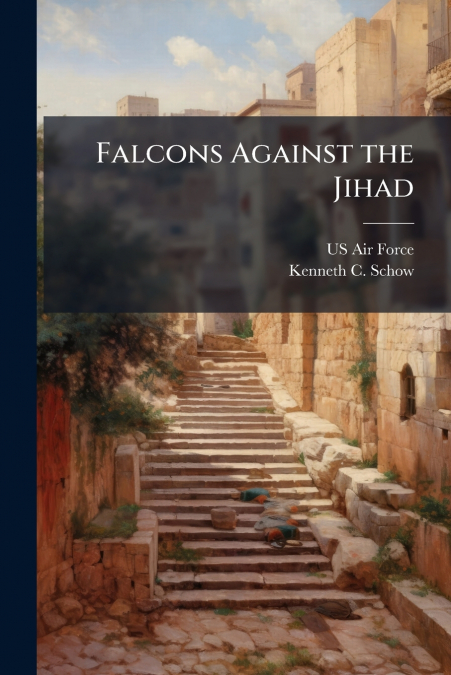
Kenneth C. Schow / US Air Force
 Librería Samer Atenea
 Kálamo Books
 Librería Elías (Asturias)
 Librería Kolima (Madrid)
 Librería Proteo (Málaga)
The analysis of this subject begins by demonstrating that Israeli air strikes in Lebanon supported a strategy of coercive diplomacy-an approach adopted when Israeli ground efforts proved unable to reduce the number of guerrilla attacks. In the course of this effort, the Israeli Air Force executed 28 air raids, all of which would have little effect on the decision calculus of the Palestinians and Shi’ite organizations in southern Lebanon. The most interesting aspect of this strategy is the fact that 90percent of the Israeli air strikes were directed against the Palestinian organizations while the evidence shows that the Shi’ites in southern Lebanon were responsible for many of the guerrilla attacks against the Israeli Defense Forces (IDF) ground troops. This study concludes that the decision to minimize air attacks against the Shi’ites was an effort on the part of senior Israeli leaders to gain long-term security on their northern border by 'signaling' their willingness to work with Nabih Berri and other Amal leaders. In addition to this, Israeli leaders were concerned that massive raids on organizations like Hizbollah would have little impact on their willingness to attack the IDF, or worse yet, would inspire them to even greater violence.In light of these political realities, the Israelis focused the air attacks on the radical Palestinian groups. Although the Israelis had an extensive intelligence base built up on the Palestinian organizations to assist them in developing their attack plans, the Israeli air strikes failed to affect the PLO. As a result, they combined with an increasingly angry Shi’ite population to execute a succession of guerrilla attacks against the IDF, which eroded the will of the Israeli leadership to stay in Lebanon.This study contends there were two reasons for this failure. First, the asymmetry of motivation favored the Shi’ites, which negated the effectiveness of air strikes as a 'carrot.' Second, the air strikes were unable to create aThis work has been selected by scholars as being culturally important, and is part of the knowledge base of civilization as we know it. This work was reproduced from the original artifact, and remains as true to the original work as possible. Therefore, you will see the original copyright references, library stamps (as most of these works have been housed in our most important libraries around the world), and other notations in the work.This work is in the public domain in the United States of America, and possibly other nations. Within the United States, you may freely copy and distribute this work, as no entity (individual or corporate) has a copyright on the body of the work.As a reproduction of a historical artifact, this work may contain missing or blurred pages, poor pictures, errant marks, etc. Scholars believe, and we concur, that this work is important enough to be preserved, reproduced, and made generally available to the public. We appreciate your support of the preservation process, and thank you for being an important part of keeping this knowledge alive and relevant.





