
Inicio > Economía, finanzas, empresa y gestión > Economía > Microeconomía > Factors Affecting Growth of SMEs in Gatundu Region North Sub-county
Factors Affecting Growth of SMEs in Gatundu Region North Sub-county

Factors Affecting Growth of SMEs in Gatundu Region North Sub-county

Mary Jokorvic

15,14 €
IVA incluido
Disponible
Editorial:
GRIN Publishing
Año de edición:
2014
Materia
Microeconomía
ISBN:
9783656639015
15,14 €
IVA incluido
Disponible

Selecciona una librería:

  • Librería Samer Atenea
  • Librería Aciertas (Toledo)
  • Kálamo Books
  • Librería Perelló (Valencia)
  • Librería Elías (Asturias)
  • Donde los libros
  • Librería Kolima (Madrid)
  • Librería Proteo (Málaga)

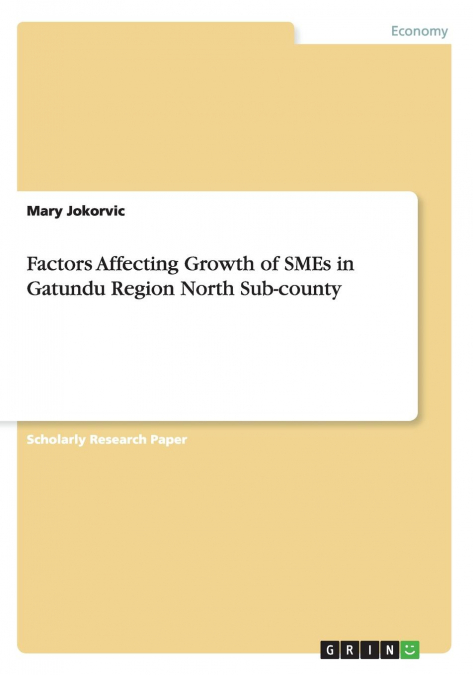
Research Paper (undergraduate) from the year 2012 in the subject Economics - Micro-economics, grade: B, The University of Chicago, language: English, abstract: About 99% of all the enterprises in the world are small or medium enterprises characterized of start up firms at the infant stage or well established SMEs. SMEs are essential in all economies especially to the developing countries characterized by major unemployment and income distribution challenges. In Kenya, SMEs are essential to the economy for which they are considered the main drivers. There are about 7.5 million SMEs in Kenya providing employment and income generating opportunities to low income sectors of the economy. The official policy framework of SMEs in Kenya is contained in the Sessional Paper No 2 of 2005: Development of Micro and Small Enterprises for Wealth and Employment Creation for Poverty Reduction. The policy forms the basis for enacting the SME Act which institutionalizes SME policy in Kenya (Syekei & Opijah, 2012). The contribution of the SMEs sector to the Gross Domestic Product (GDP) in Kenya increased from 13.8 percent in 1993 to about 40 percent by 2008. The sector further provides approximately 80% of the total employment and contributes about 92% of the new jobs created within the economy. The sector serves as the bedrock for industrializing the country in the future (Capital Markets Authority, 2010). In the developing countries such as Kenya, with large informal or micro enterprise sectors, SMEs constitute the middle of the size range, hence their strategic importance. SMEs are considerably more complicated in terms of the organizational structure as opposed to microenterprises but less complicated as opposed to large corporations with layers of management and high division of labor among other characteristics. In terms of technology SMEs are intermediate between high labor intensive technologies and high capital intensive technologies providing SMEs with a special role in

Artículos relacionados

  • Optimal Transport Methods in Economics
    Alfred Galichon
    Optimal Transport Methods in Economics is the first textbook on the subject written especially for students and researchers in economics. Optimal transport theory is used widely to solve problems in mathematics and some areas of the sciences, but it can also be used to understand a range of problems in applied economics, such as the matching between job seekers and jobs, the de...
  • Structural Econometric Modeling in Industrial Organization and Quantitative Marketing
    Ali Hortaçsu / Joonhwi Joo
    A concise and rigorous introduction to widely used approaches in structural econometric modeling Structural econometric modeling specifies the structure of an economic model and estimates the model’s parameters from real-world data. Structural econometric modeling enables better economic theory-based predictions and policy counterfactuals. This book offers a primer on recent de...
  • Identity Economics
    George A. Akerlof / Rachel E. Kranton
    How identity influences the economic choices we makeIdentity Economics provides an important and compelling new way to understand human behavior, revealing how our identities-and not just economic incentives-influence our decisions. In 1995, economist Rachel Kranton wrote future Nobel Prize-winner George Akerlof a letter insisting that his most recent paper was wrong. Identity,...
    Disponible

    28,26 €

  • Economic Foundations of Symmetric Programming
    Quirino Paris
    ...
  • Profit Theory and Capitalism
    Mark Obrinsky
    The pursuit of profit by business motivates the capitalist economic system. Understanding profits, therefore, especially the source of profits, is essential to an understanding of capitalism. Mark Obrinsky claims that there has never been an adequate profit theory in mainstream economics. To find the source of profits, he argues, one needs to look beyond ownership of the produc...
    Disponible

    31,88 €

  • The Medieval Super-Companies
    Edwin S. Hunt / Edwin SHunt
    ...