
Inicio > Derecho > Derecho internacional > Extraterritorial Apprehensions for the International Criminal Court
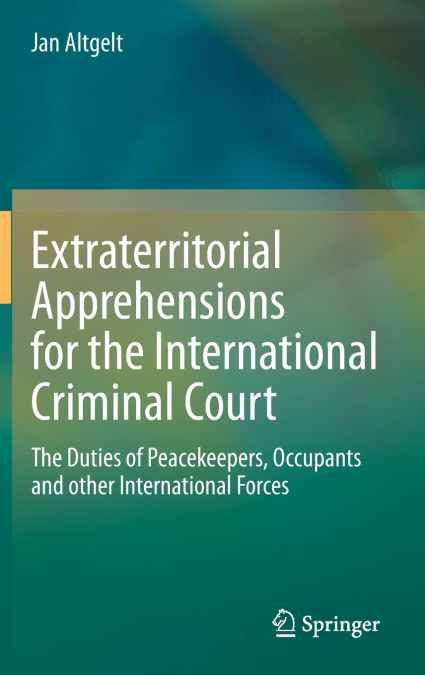
Extraterritorial Apprehensions for the International Criminal Court

Extraterritorial Apprehensions for the International Criminal Court

Jan Altgelt

218,75 €
IVA incluido
Consulta disponibilidad
Editorial:
Springer Nature B.V.
Año de edición:
2024
Materia
Derecho internacional
ISBN:
9783031458958

Selecciona una librería:

  • Librería Samer Atenea
  • Librería Aciertas (Toledo)
  • Kálamo Books
  • Librería Perelló (Valencia)
  • Librería Elías (Asturias)
  • Donde los libros
  • Librería Kolima (Madrid)
  • Librería Proteo (Málaga)

The starting point of this book is the generally shared observation that in violence-torn areas of limited statehood, the civilian population is often subject to deliberate attacks. This violence often escalates to core crimes such as war crimes, crimes against humanity and even genocide. The International Criminal Court (ICC) could potentially deter such crimes. In order to do so, it largely depends on the cooperation of the states on the territory of which alleged core criminals operate. Since such states are often unwilling or unable to cooperate, the book explores whether the ICC could instead seek assistance from international forces such as UN peace support operations, UN-mandated missions, and belligerent occupants.The book covers, on the one hand, the law and practice of the UN Security Council with regard to mandating international forces to arrest and transfer alleged offenders to the ICC or to other international courts. On the other, it addresses to what extent international forces may or must hand alleged offenders over to the ICC, regardless of such mandates. More precisely, the book examines whether the duties to prosecute genocide, torture, enforced disappearance, grave breaches and other war crimes apply extraterritorially and - if so - whether international forces can discharge these duties by transferring suspects to the ICC.At the same time, the book addresses the limitations to such extraterritorial action: firstly, to what extent the prohibition of the use of force and the principle of territorial sovereignty restrict extraterritorial deprivations of liberty and transfer to the ICC. Secondly, it explores the restrictions and permissions that the law of occupation and other norms of international humanitarian law impose on such apprehensions and transfers. Finally, it discusses how international forces can uphold the right to liberty and security as well as the principle of non-refoulement when they extraterritorially apprehend ICC suspects. This also reflects the book’s relevance with regard to the more general debate on the extraterritorial application of human rights.

Artículos relacionados

  • Comparative regulation, economic analysis, and applications of private equity in the united states and european union
    Irini Liakopoulou
    The present work examines the economics and legal doctrine of private equity. After a consideration of private equity’s origins, the book will explore the evolution of private equity in the United States and Europe. The reference economic model then will be reconstructed, with particular attention to financial flows to and from private equity firms and funds. This reconstructio...
  • Complicity in International Law
    Dimitris Liakopoulous
    Complicity in International Law aims to analyze questions arising from a state’s complicity in conflict with another state or an international organization. On the basis of international legal provisions, a state that assists the illicit fact of another state or an international organization in turn commits an offense if it is aware of the main fact and is bound by the same obl...
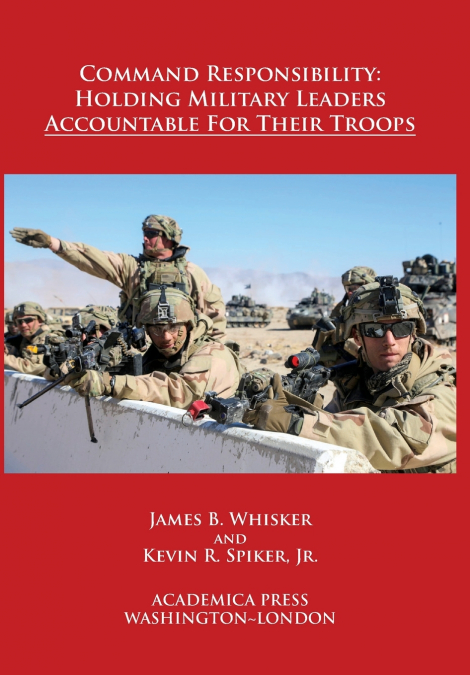
  • Command responsibility
    James B Whisker / Kevin R Spiker
    Command responsibility, or executive accountability, assumes that leaders are responsible for the actions of their subordinates. If subordinates misbehave, violate basic moral laws, transgress international law, or thwart international standards of behavior, their leader may be called before to justice. Standards that set the boundaries of human action have been evolving for ma...
  • International Organizations and Reparations
    Dimitris Liakopoulos
    In the first part of this book, noted legal scholar Dimtris Liakopoulos deals with reconstructing the legal regulatory framework governing human rights violations in the activities of organizations. After identifying rules that are generally applicable to organizations’ offenses and govern the profile of reparations, this study assesses primary rules that guarantee the right to...
  • International Organizations and Legal Sanctions Against Governments
    Dimitris Liakopoulos
    This book examines the relationship between governments and international organizations under international law. After surveying the policing powers of international organizations under international law, it illustrates some normative aspects of law that distinguish regulation from enforcement via study of recent legal cases before international judicial bodies. According to Di...
  • The EU Foreign Subsidies Regulation
    Andreas Reindl / Isabelle Van Damme
    'The EU Foreign Subsidies Regulation' is a pioneering manual authored by legal experts Andreas Reindl and Isabelle Van Damme. This essential guide, the first of its kind, is tailored for legal practitioners, offering a thorough exploration of the tools and mechanisms embedded within this novel European regulatory framework. The authors meticulously dissect the EU Foreign Subsid...