 Librería Samer Atenea
 Kálamo Books
 Librería Elías (Asturias)
 Librería Kolima (Madrid)
 Librería Proteo (Málaga)
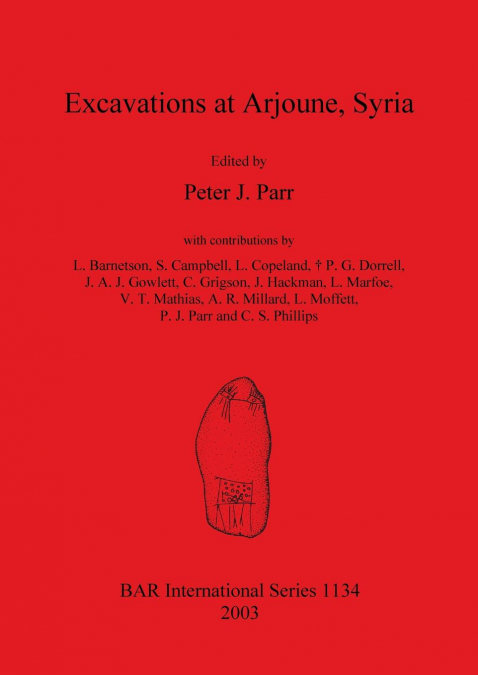
This study looks at the settlement site of Arjourne, situated on a low rise overlooking the Orontes River just South of Lake Homs in Syria. This site was first settled in the middle of the 6th millennium BC. The majority of the pottery and stone objects from this period link this site to other 'peripheral Halaf culture' sites, and this consisted of a mix of Levantine and northern Mesopotamian influences. This shows that the settlers at this site may well have come from nearby culturally-related sites, but this cannot be proved. The archaeozoological evidence shows that these settlers must have kept domesticated livestock, and they must also have been farmers judging by the various plant remains, suggesting that they were at least partly sedentary. A number of pits were excavated at this site, and these were generally filled with rubbish from the occupation of the site, but the nature of this rubbish was in horizontal layers, indicating a gradual build up on habitation floors rather than as part of rubbish-filled pits. These are interpreted as the emplacements for small shelters which served only the temporary needs of the seasonal farmers who used this site. This site was therefore very small in terms of population at any one time, although the radiocarbon evidence suggests that each 'pit' could have been in use for up to 200 to 250 years. Judging from the number of pits this means that the settlement could have been inhabited for at least 700 years or more. After abandonment the site was again inhabitedin the 5th millennium BC, and was similar in nature to before, except for a few new pottery types. However, one major difference was the effect of the secondary products revolution, increasing the amount of cattle and sheep, but reducing the amount of goats present at the site, as wool and dairy products became more important. Donkeys and Horses also became more important at this time. Arjourne seems to have been abandoned for several thousand years following this phase, and it may have been used as a burial ground during the 3rd millennium BC. However, the site was not permanently resettled until the 4th or early 3rd century BC, and this was only on a small scale and was not occupied for very long. Much later a Muslim cemetery was placed on the highest part of the site, but this is no longer in use. The evidence from the excavations at Arjourne is presented in this book in fourteen papers, and these are as follows: (1) Synopsis; (2) The environmental setting; (3) The site and its excavation; (4) The resistivity survey; (5) The AMS radiocarbon dates: an analysis and interpretation; (6) The prehistoric pottery; (7) The lithic industries; (8) The groundstone objects; (9) Other prehistoric artefacts; (10) The prehistoric burial; (11) Animal husbandry in the Late Neolithic and Chalcolithic at Arjourne: the secondary products revolution revisited; (12) Wild and cultivated food plants and the evidence for crop processing activities; (13) The Persian-Hellenistic occupation; (14) Concluding remarks.With contributions by L. Barnetson, S. Campbell, L. Copeland, † P.G. Dorrell, J.A.J. Gowlett, C. Grigson, J. Hackman, L. Marfoe, V.T. Mathias, A.R. Millard, L. Moffett, P.J. Parr and C.S. Phillips.