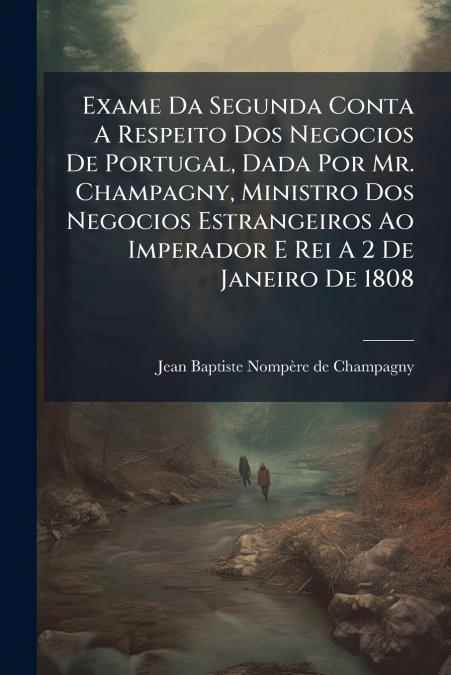
Jean-Baptiste Nompère de Champagny
 Librería Samer Atenea
 Kálamo Books
 Librería Elías (Asturias)
 Librería Kolima (Madrid)
 Librería Proteo (Málaga)
'Exame Da Segunda Conta A Respeito Dos Negocios De Portugal, Dada Por Mr. Champagny, Ministro Dos Negocios Estrangeiros Ao Imperador E Rei A 2 De Janeiro De 1808' offers a detailed examination of Portuguese affairs as presented by Jean-Baptiste Nompère de Champagny, the French Minister of Foreign Affairs, to the Emperor in early 1808. This historical document provides insights into the political and economic dynamics of Portugal during a pivotal period. The text delivers a contemporary perspective on the state of Portuguese affairs, reflecting the views and assessments of a key figure in the Napoleonic administration. Readers interested in European history, particularly the Napoleonic era and its impact on Portugal, will find this work valuable. It sheds light on the complex relationships between nations and the strategic considerations that shaped European politics at the time. This account, delivered directly to the Emperor, provides a first-hand glimpse into the decision-making processes and geopolitical evaluations of the era.This work has been selected by scholars as being culturally important, and is part of the knowledge base of civilization as we know it. This work was reproduced from the original artifact, and remains as true to the original work as possible. Therefore, you will see the original copyright references, library stamps (as most of these works have been housed in our most important libraries around the world), and other notations in the work.This work is in the public domain in the United States of America, and possibly other nations. Within the United States, you may freely copy and distribute this work, as no entity (individual or corporate) has a copyright on the body of the work.As a reproduction of a historical artifact, this work may contain missing or blurred pages, poor pictures, errant marks, etc. Scholars believe, and we concur, that this work is important enough to be preserved, reproduced, and made generally available to the public. We appreciate your support of the preservation process, and thank you for being an important part of keeping this knowledge alive and relevant.