 Librería Samer Atenea
 Kálamo Books
 Librería Elías (Asturias)
 Librería Kolima (Madrid)
 Librería Proteo (Málaga)
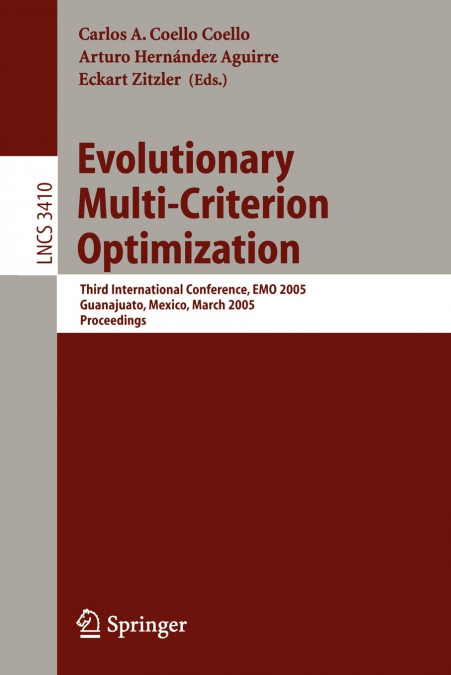
Multicriterion optimization refers to problems with two or more objectives (n- mally in con?ict with each other) which must be simultaneously satis?ed. Multicriterion optimization problems have not one but a set of solutions (which represent trade-o?s among the objectives), which are called Pareto optimal - lutions. Thus, the main goal in multicriterion optimization is to ?nd or to - proximate the set of Pareto optimal solutions. Evolutionary algorithms have been used for solving multicriterion optimization problems for over two decades, gaining an increasing popularity over the last 10 years. The 3rd International Conference on Evolutionary Multi-criterion Optimi- tion(EMO2005)washeldduringMarch9-11,2005,inGuanajuato,M´ exico.This wasthethirdinternationalconferencededicatedentirelytothisimportanttopic, followingthesuccessfulEMO2001andEMO2003conferences,whichwereheldin Z¨ urich,SwitzerlandinMarch2001,andinFaro,PortugalinApril2003,respectively. The EMO 2005 scienti?c program included two keynote addresses, one given by Peter Fleming on an engineering design perspective of many-objective op- mization, and the other given by Milan Zeleny on the evolution of optimality. In addition, three tutorials were presented, one on metaheuristics for multiobj- tivecombinatorialoptimizationbyXavierGandibleux,anotheronmultiobjective evolutionary algorithms by Gary B. Lamont, and a third one on performance assessment of multiobjective evolutionary algorithms by Joshua D. Knowles.