

Annie Wood Besant / Theosophical Society (Great Britain)
 Librería Samer Atenea
 Kálamo Books
 Librería Elías (Asturias)
 Librería Kolima (Madrid)
 Librería Proteo (Málaga)
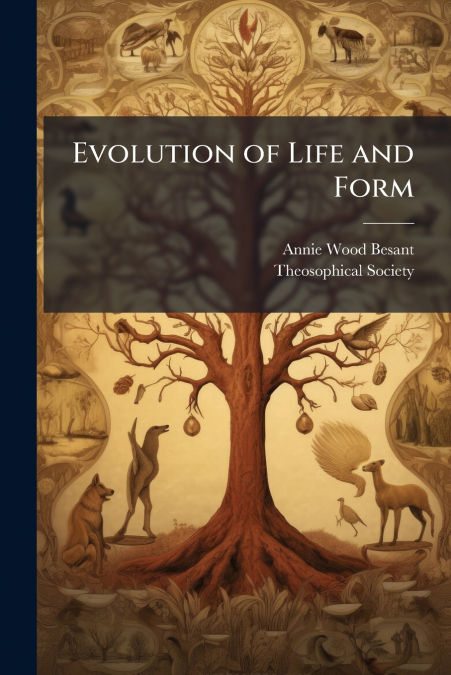
Delve into the profound synthesis of science and spirituality with Annie Besant’s 'Evolution of Life and Form.' This volume comprises four lectures delivered at the Theosophical Society’s anniversary meeting in Adyar, Madras, in 1898. Besant, a prominent theosophist and social reformer, explores the intricate relationship between evolutionary processes and the underlying spiritual principles that govern the cosmos. In 'Evolution of Life and Form,' Besant elucidates the theosophical perspective on the evolution of life, drawing connections between ancient wisdom and contemporary scientific understanding. Readers will discover insights into the nature of consciousness, the development of forms, and the spiritual destiny of humanity. This work offers a unique lens through which to view the unfolding of life on Earth, blending scientific inquiry with profound spiritual insight. A valuable addition to any collection on theosophy, evolutionary thought, and the convergence of science and spirituality.This work has been selected by scholars as being culturally important, and is part of the knowledge base of civilization as we know it. This work was reproduced from the original artifact, and remains as true to the original work as possible. Therefore, you will see the original copyright references, library stamps (as most of these works have been housed in our most important libraries around the world), and other notations in the work.This work is in the public domain in the United States of America, and possibly other nations. Within the United States, you may freely copy and distribute this work, as no entity (individual or corporate) has a copyright on the body of the work.As a reproduction of a historical artifact, this work may contain missing or blurred pages, poor pictures, errant marks, etc. Scholars believe, and we concur, that this work is important enough to be preserved, reproduced, and made generally available to the public. We appreciate your support of the preservation process, and thank you for being an important part of keeping this knowledge alive and relevant.





