 Librería Samer Atenea
 Kálamo Books
 Librería Elías (Asturias)
 Librería Kolima (Madrid)
 Librería Proteo (Málaga)
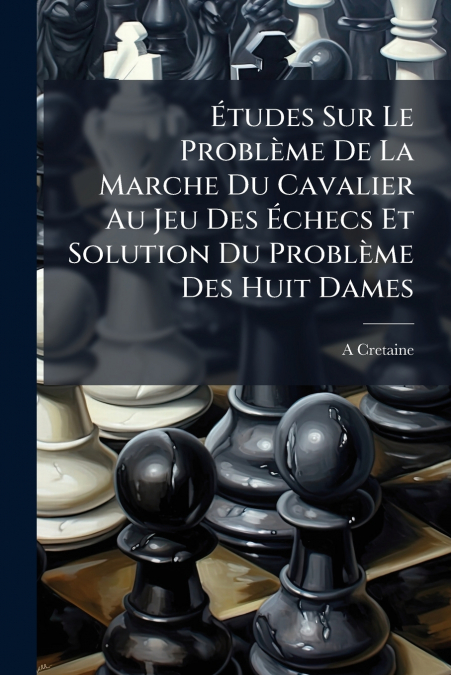
Études Sur Le Problème De La Marche Du Cavalier Au Jeu Des Échecs Et Solution Du Problème Des Huit Dames, written by A. Cretaine and originally published in 1865, delves into two intriguing mathematical problems related to chess. The first section explores the knight’s tour, a classic puzzle involving moving a knight piece on a chessboard to occupy each square exactly once. The second part tackles the eight queens puzzle, which challenges the solver to place eight queens on a chessboard so that no two queens threaten each other. This work presents a detailed examination of these combinatorial challenges. It offers insights into the techniques and solutions devised in the 19th century, making it a valuable resource for chess enthusiasts, mathematics historians, and anyone interested in recreational mathematics and problem-solving. Cretaine’s analysis provides a fascinating glimpse into the intellectual pursuits of the era and the enduring appeal of these logical puzzles.This work has been selected by scholars as being culturally important, and is part of the knowledge base of civilization as we know it. This work was reproduced from the original artifact, and remains as true to the original work as possible. Therefore, you will see the original copyright references, library stamps (as most of these works have been housed in our most important libraries around the world), and other notations in the work.This work is in the public domain in the United States of America, and possibly other nations. Within the United States, you may freely copy and distribute this work, as no entity (individual or corporate) has a copyright on the body of the work.As a reproduction of a historical artifact, this work may contain missing or blurred pages, poor pictures, errant marks, etc. Scholars believe, and we concur, that this work is important enough to be preserved, reproduced, and made generally available to the public. We appreciate your support of the preservation process, and thank you for being an important part of keeping this knowledge alive and relevant.