

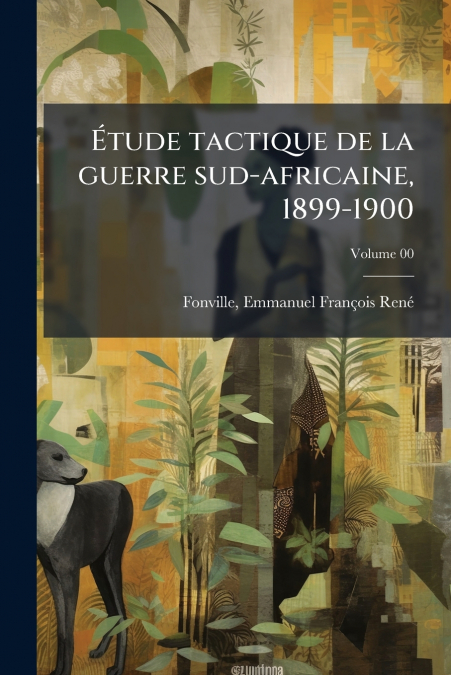
Emmanuel François René Fonville
 Librería Samer Atenea
 Kálamo Books
 Librería Elías (Asturias)
 Librería Kolima (Madrid)
 Librería Proteo (Málaga)
Etude tactique de la guerre sud-africaine, 1899-1900 offre une analyse approfondie des stratégies et tactiques employées durant la guerre des Boers. Cet ouvrage, initialement publié en 1903, examine en détail les manœuvres militaires et les décisions stratégiques qui ont façonné le conflit. L’auteur, Emmanuel François René Fonville, dissèque les opérations avec une précision méticuleuse, offrant aux lecteurs une compréhension claire des défis et des complexités de cette guerre.Ce volume est une ressource précieuse pour les historiens militaires, les étudiants et tous ceux qui s’intéressent à l’histoire militaire et à l’évolution des tactiques de guerre à la fin du XIXe siècle. Il met en lumière les aspects cruciaux de la guerre sud-africaine, tout en explorant le contexte plus large de l’impérialisme et des conflits coloniaux.This work has been selected by scholars as being culturally important, and is part of the knowledge base of civilization as we know it. This work was reproduced from the original artifact, and remains as true to the original work as possible. Therefore, you will see the original copyright references, library stamps (as most of these works have been housed in our most important libraries around the world), and other notations in the work.This work is in the public domain in the United States of America, and possibly other nations. Within the United States, you may freely copy and distribute this work, as no entity (individual or corporate) has a copyright on the body of the work.As a reproduction of a historical artifact, this work may contain missing or blurred pages, poor pictures, errant marks, etc. Scholars believe, and we concur, that this work is important enough to be preserved, reproduced, and made generally available to the public. We appreciate your support of the preservation process, and thank you for being an important part of keeping this knowledge alive and relevant.





