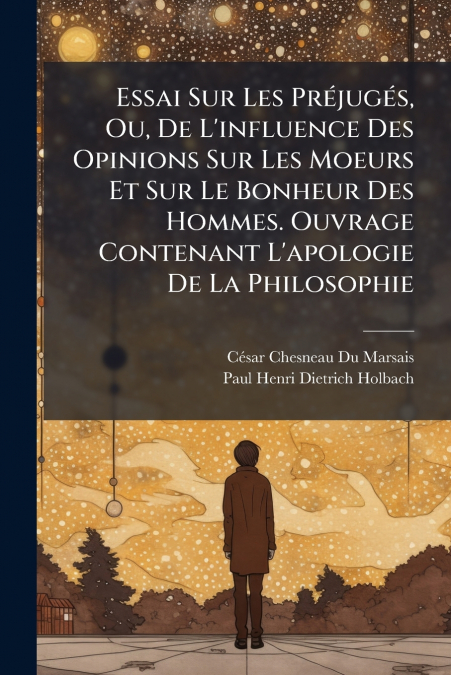
César Chesneau Du Marsais / Paul Henri Dietrich Holbach (baron d’))
 Librería Samer Atenea
 Kálamo Books
 Librería Elías (Asturias)
 Librería Kolima (Madrid)
 Librería Proteo (Málaga)
Essai Sur Les Préjugés, Ou, De L’influence Des Opinions Sur Les Moeurs Et Sur Le Bonheur Des Hommes. Ouvrage Contenant L’apologie De La Philosophie explores the profound impact of prejudices and opinions on human behavior and happiness. Written in the tradition of Enlightenment philosophy, this work examines how prevailing beliefs shape customs, societal norms, and individual well-being. The authors, César Chesneau Du Marsais and Paul Henri Dietrich Holbach, offer an apology for philosophy, arguing for its crucial role in dismantling harmful prejudices and fostering a more rational and equitable society. This essay delves into the intricate relationship between thought and action, revealing how deeply ingrained opinions can either elevate or degrade the human condition. A significant contribution to the intellectual discourse of its time, this book remains relevant for its insights into the enduring power of ideas.This work has been selected by scholars as being culturally important, and is part of the knowledge base of civilization as we know it. This work was reproduced from the original artifact, and remains as true to the original work as possible. Therefore, you will see the original copyright references, library stamps (as most of these works have been housed in our most important libraries around the world), and other notations in the work.This work is in the public domain in the United States of America, and possibly other nations. Within the United States, you may freely copy and distribute this work, as no entity (individual or corporate) has a copyright on the body of the work.As a reproduction of a historical artifact, this work may contain missing or blurred pages, poor pictures, errant marks, etc. Scholars believe, and we concur, that this work is important enough to be preserved, reproduced, and made generally available to the public. We appreciate your support of the preservation process, and thank you for being an important part of keeping this knowledge alive and relevant.