 Librería Samer Atenea
 Kálamo Books
 Librería Elías (Asturias)
 Librería Kolima (Madrid)
 Librería Proteo (Málaga)
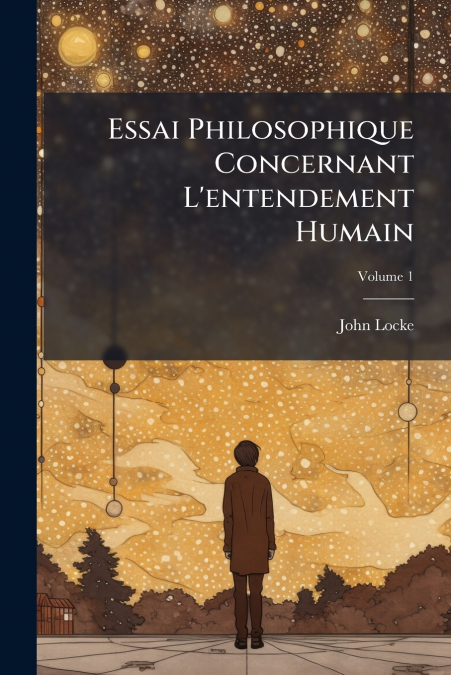
Essai Philosophique Concernant L’entendement Humain, Volume 1, by John Locke, is a foundational work in the field of epistemology and a cornerstone of Enlightenment philosophy. This French edition invites readers to delve into Locke’s systematic investigation of the origins, certainty, and extent of human knowledge. Locke challenges the doctrine of innate ideas, proposing instead that the mind is a blank slate at birth, shaped by experience and reflection. This volume explores key concepts such as perception, simple and complex ideas, and the role of language in shaping thought. Locke’s emphasis on empirical observation and rational inquiry influenced generations of thinkers and continues to resonate in contemporary philosophical discourse. This essential text offers profound insights into the nature of human understanding and its implications for knowledge, belief, and the pursuit of truth.This work has been selected by scholars as being culturally important, and is part of the knowledge base of civilization as we know it. This work was reproduced from the original artifact, and remains as true to the original work as possible. Therefore, you will see the original copyright references, library stamps (as most of these works have been housed in our most important libraries around the world), and other notations in the work.This work is in the public domain in the United States of America, and possibly other nations. Within the United States, you may freely copy and distribute this work, as no entity (individual or corporate) has a copyright on the body of the work.As a reproduction of a historical artifact, this work may contain missing or blurred pages, poor pictures, errant marks, etc. Scholars believe, and we concur, that this work is important enough to be preserved, reproduced, and made generally available to the public. We appreciate your support of the preservation process, and thank you for being an important part of keeping this knowledge alive and relevant.