Librería Samer Atenea
 Kálamo Books
 Librería Elías (Asturias)
 Librería Kolima (Madrid)
 Librería Proteo (Málaga)
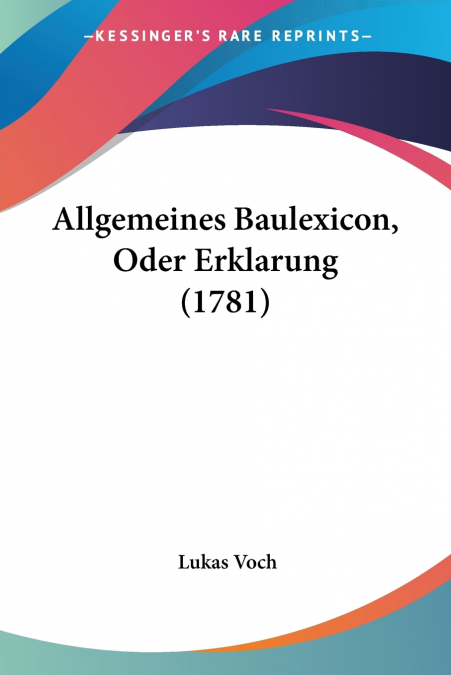
Erste Gründe Zu Gartenrißen Nach Mustern, by Lukas Voch, offers a fascinating glimpse into 18th-century garden design. This book, subtitled ’In XIV Kupfertabellen Jungen Gärtnern Und Andern Liebhabern Zum Besten Entworfen...’, presents a collection of garden plans and designs in fourteen copperplate engravings, intended for young gardeners and gardening enthusiasts. It showcases the aesthetic principles and practical considerations of garden layout during that era. Voch’s work provides valuable insights into the formal garden styles prevalent in Germany and Europe. The book serves as both a historical document and a source of inspiration for understanding the evolution of landscape architecture. This edition offers a carefully reproduced and accessible version of Voch’s original designs, preserving its value for historians, landscape architects, and anyone interested in the art of garden design.This work has been selected by scholars as being culturally important, and is part of the knowledge base of civilization as we know it. This work was reproduced from the original artifact, and remains as true to the original work as possible. Therefore, you will see the original copyright references, library stamps (as most of these works have been housed in our most important libraries around the world), and other notations in the work.This work is in the public domain in the United States of America, and possibly other nations. Within the United States, you may freely copy and distribute this work, as no entity (individual or corporate) has a copyright on the body of the work.As a reproduction of a historical artifact, this work may contain missing or blurred pages, poor pictures, errant marks, etc. Scholars believe, and we concur, that this work is important enough to be preserved, reproduced, and made generally available to the public. We appreciate your support of the preservation process, and thank you for being an important part of keeping this knowledge alive and relevant.