
Inicio > Economía, finanzas, empresa y gestión > Economía > Economía urbana > Equilibrium and Advanced Transportation Modelling
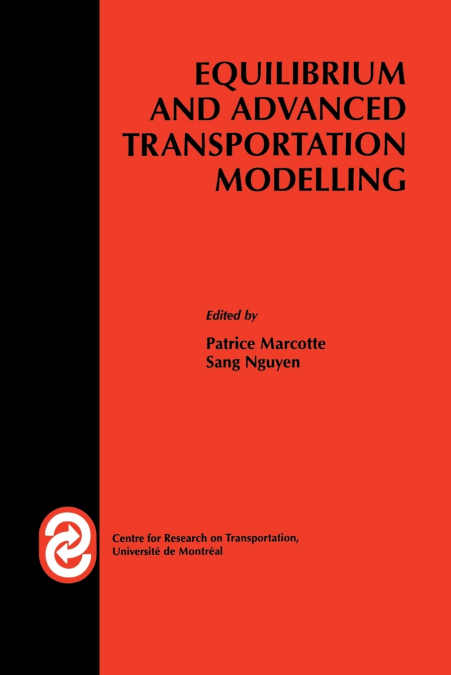
Equilibrium and Advanced Transportation Modelling

Equilibrium and Advanced Transportation Modelling


207,45 €
IVA incluido
Disponible
Editorial:
Springer Nature B.V.
Año de edición:
2013
Materia
Economía urbana
ISBN:
9781461376385
207,45 €
IVA incluido
Disponible

Selecciona una librería:

  • Librería Samer Atenea
  • Librería Aciertas (Toledo)
  • Kálamo Books
  • Librería Perelló (Valencia)
  • Librería Elías (Asturias)
  • Donde los libros
  • Librería Kolima (Madrid)
  • Librería Proteo (Málaga)

Each chapter in Equilibrium and Advanced Transportation Modelling develops a topic from basic concepts to the state-of-the-art, and beyond. All chapters relate to aspects of network equilibrium. Chapter One advocates the use of simulation models for the representation of traffic flow movements at the microscopic level. Chapter Two presents travel demand systems for generating trip matrices from activity-based models, taking into account the entire daily schedule of network users. Chapter Three examines equilibrium strategic choices adopted by the passengers of a congested transit system, carefully addressing line selection at boarding and transfer nodes. Chapter Four provides a critical appraisal of the traditional process that consists in sequentially performing the tasks of trip generation, trip distribution, mode split and assignment, and its impact on the practice of transportation planning. Chapter Five gives an insightful overview of stochastic assignment models, both in the static and dynamic cases. Chapters Six and Seven investigate the setting of tolls to improve traffic flow conditions in a congested transportation network. Chapter Eight provides a unifying framework for the analysis of multicriteria assignment models. In this chapter, available algorithms are summarized and an econometric perspective on the estimation of heterogeneous preferences is given. Chapter Nine surveys the use of hyperpaths in operations research and proposes a new paradigm of equilibrium in a capacitated network, with an application to transit assignment. Chapter Ten analyzes the transient states of a system moving towards equilibrium, using the mathematical framework of projected dynamical systems. Chapter Eleven discusses an in-depth survey of algorithms for solving shortest path problems, which are pervasive to any equilibrium algorithm. The chapter devotes special attention to the computation of dynamic shortest paths and to shortest hyperpaths. The final chapter considers operations research tools for reducing traffic congestion, in particular introducing an algorithm for solving a signal-setting problem formulated as a bilevel program.

Artículos relacionados

  • Technological Change and the British Iron Industry, 1700-1870
    Charles K. Hyde
    This book describes technological change in an industry that played a central role in the Indsutrial Revolution. While earlier scholars have examined isolated aspects of ironmaking in the eighteenth- and nineteenth-century Britain, Charles Hyde surveys all aspects of its development. Costs, prices, profits, shrewd leaders, competition, new inventions, and productivity all figur...
    Disponible

    71,94 €

  • Corporate Governance in Asia
    ...
    Disponible

    72,99 €

  • The European Guilds
    Sheilagh Ogilvie
    A comprehensive analysis of European craft guilds through eight centuries of economic historyGuilds ruled many crafts and trades from the Middle Ages to the Industrial Revolution, and have always attracted debate and controversy. They were sometimes viewed as efficient institutions that guaranteed quality and skills. But they also excluded competitors, manipulated markets, and ...
  • Technological Change and the British Iron Industry, 1700-1870
    Charles K. Hyde
    This book describes technological change in an industry that played a central role in the Indsutrial Revolution. While earlier scholars have examined isolated aspects of ironmaking in the eighteenth- and nineteenth-century Britain, Charles Hyde surveys all aspects of its development. Costs, prices, profits, shrewd leaders, competition, new inventions, and productivity all figur...
  • Technology Differences over Space and Time
    Francesco Caselli
    Technology Differences over Space and Time looks at how countries use their productive resources-such as workers, skills, equipment and structures, and natural resources. Francesco Caselli develops methods to assess the efficiency with which productive inputs are used, and how these efficiencies vary across countries and over time.Caselli finds that richer countries use skilled...
  • Cybersecurity Measures for Logistics Industry Framework
    Global supply chains are becoming more customer-centric and sustainable thanks to next-generation logistics management technologies. Automating logistics procedures greatly increases the productivity and efficiency of the workflow. There is a need, however, to create flexible and dynamic relationships among numerous stakeholders and the transparency and traceability of the supp...