Equal to What? Feminism in a Fractured Democracy

Equal to What? Feminism in a Fractured Democracy

J.J. Ramos

29,66 €
IVA incluido
Disponible
Editorial:
J.J. Ramos
Año de edición:
2026
Materia
Políticas del Gobierno central
ISBN:
9798235558892
29,66 €
IVA incluido
Disponible

Selecciona una librería:

  • Librería Samer Atenea
  • Kálamo Books
  • Librería Elías (Asturias)
  • Librería Kolima (Madrid)
  • Librería Proteo (Málaga)

'Equality' is the word the political slogan never specifies.Equal in which sense? To whom? Measured how? Enforced by what?In Equal to What?, J.J. Ramos argues that the second-wave feminist project of 'achieving equality' rested on an assumption that has quietly become false: that the surrounding democratic-institutional infrastructure would continue to function as the medium in which feminist law operates. The courts that interpret the statutes. The agencies that enforce them. The franchise that elects the legislators who write them. The civic organizations that mobilize the constituency. Each of these institutions has been substantially weakened in ways the movement did not adequately see. The visible reversals of the 2020s - Dobbs in 2022, Loper Bright in 2024, the state-level voter-restriction wave that followed Shelby County in 2013 - are not anomalies. They are the predictable result of a long-running institutional project whose feminist response has been small relative to the scale of what was undone.The book is in four parts. Part I unpacks the four meanings the word equality holds in tension and traces the inheritance from Seneca Falls 1848 through the second-wave statute portfolio to the present crack in the institutional floor. Part II walks through the four institutional pillars under pressure: the courts, the administrative agencies, the franchise, and the civic-society infrastructure women historically built and ran. Part III names the four shapes of degraded equality the present moment has produced: rights without remedy, form without substance, vote without voice, recognition without redistribution. Part IV proposes the constructive program: building new institutions rather than only repairing old ones, treating equality as a verb rather than a noun, and constructing the cross-class multiracial coalitions the work requires.Drawing on Catharine MacKinnon’s substantive-equality theory, Lani Guinier’s The Tyranny of the Majority, Nancy Fraser’s recognition / redistribution / representation triad, Robert Putnam’s Bowling Alone, Theda Skocpol’s Diminished Democracy, and the documented democratic-crisis literature from Levitsky and Ziblatt onward, Ramos joins the democratic-decline literature and the feminist-legal-equality literature into a sustained argument that the present feminist project is, centrally, democratic repair.For readers of How Democracies Die, The Tyranny of the Majority, Sex Equality, Scales of Justice, Bowling Alone, and the rest of the J.J. Ramos catalog - written for the moment when the institutional ground is shifting and the inherited vocabulary does not quite reach the new terrain.

Artículos relacionados

  • Gender Identities in Italy in the First Millennium BC
    This book includes papers from a conference held at the Institute of Classical Studies, London, in June 2006.                         ...
    Disponible

    77,26 €

  • Crossing the catwalk
    Laura Cherrie Beaney
    In the 1930s, Freud observed that 'when you meet a human being, the first distinction you make is ’male or female?’ and you are accustomed to make the distinction with unhesitating certainty.' As Freud suggests, society is divisible by gender. We are taken to be either 'male' or 'female.' This notion seems to be fixed within our culture and is often unquestioned. In this dynami...
  • Crossing the catwalk
    Laura Cherrie Beaney
    In the 1930s, Freud observed that 'when you meet a human being, the first distinction you make is ’male or female?’ and you are accustomed to make the distinction with unhesitating certainty.' As Freud suggests, society is divisible by gender. We are taken to be either 'male' or 'female.' This notion seems to be fixed within our culture and is often unquestioned. In this dynami...
    Disponible

    51,44 €

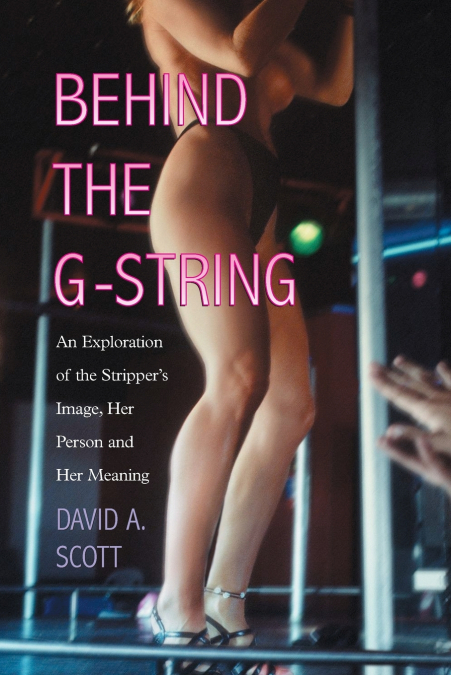
  • Behind the G-String
    David A. Scott
    In recent years, the number of strip clubs in the United States has increased dramatically. Dressed up with terms such as 'gentlemen’s clubs,' they often feature valet parking, limousines, executive dining rooms, extravagant menus-and, of course, topless or nude women dancing on stage. Stripping has become a big business, with over 3.5 million people, primarily men, attendin...
    Disponible

    42,71 €

  • A Genealogy of the Wives of the American Presidents and Their First Two Generations of Descent
    Craig Hart
    From Martha Washington to Laura Bush, the wife of each U.S. president has found her place in history, often setting trends and doing important work for the nation. This reference work traces the lineage of all presidents’ wives, arranged alphabetically from Abigail Adams to Jane Wyman. Genealogy reveals that some of the women are connected to one another through common anc...
    Disponible

    71,73 €

  • Stereotypes of Women in Power
    Barbara Garlick / Suzanne Dixon
    ...

Otros libros del autor

  • The Women’s Republic
    J.J. Ramos
    institutional form that the constituency owns and governs. The book argues that the republic women need is not a metaphor but a political form: female-majority governance of the institutions that touch female lives, backed by ownership, law, and organized constituency.The book is in four parts. Part I redefines 'republic' as a working political form, names the four domains a wo...
    Disponible

    29,59 €

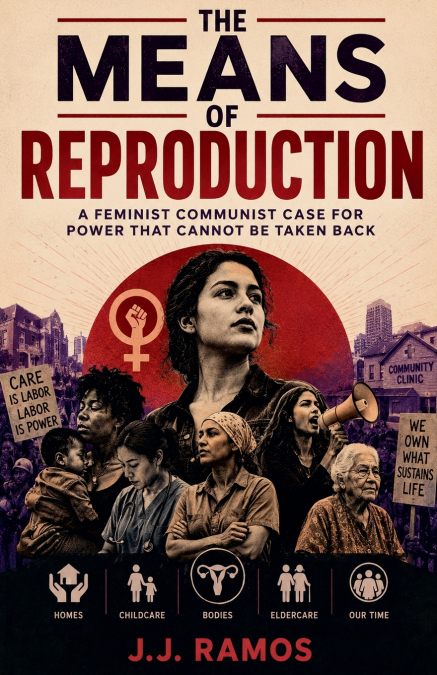
  • The Means of Reproduction
    J.J. Ramos
    women have always been admitted to structures that men own, and admission is permission, and permission can be withdrawn.The argument is feminist communist, and the words are used carefully. Feminist because the labor at the center of the book is the labor that produces and reproduces the conditions of human life: the wombs, the homes, the childcare, the eldercare, the kin netw...
    Disponible

    27,81 €

  • Power in Her Hands
    J.J. Ramos
    There is a labor that does not appear in the productivity statistics.It begins before the visible workday begins. It includes the dressing of children, the calling of an aging parent’s doctor, the texting of the sibling whose marriage is wobbling, the cognitive list of what the household needs, the emotional repair after a conflict, the network maintenance that keeps a family o...
    Disponible

    27,62 €

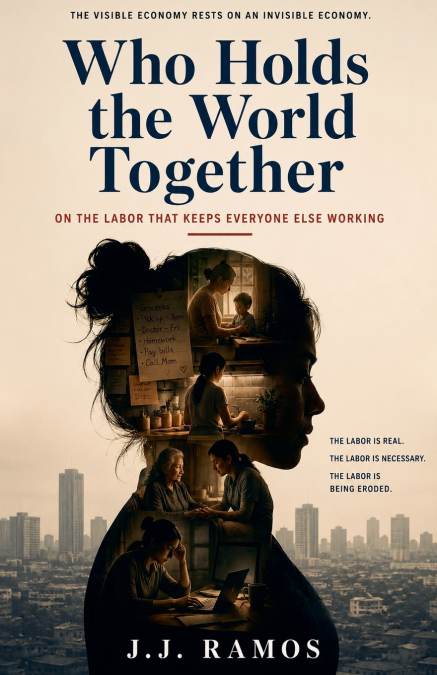
  • Who Holds the World Together
    J.J. Ramos
    There is a labor that does not appear in the productivity statistics.It begins before the visible workday begins. It includes the dressing of children, the calling of an aging parent’s doctor, the texting of the sibling whose marriage is wobbling, the cognitive list of what the household needs, the emotional repair after a conflict, the network maintenance that keeps a family o...
    Disponible

    28,59 €

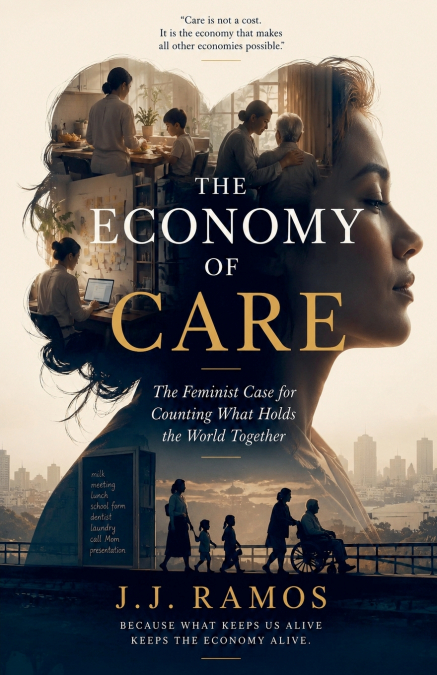
  • The Economy of Care
    J.J. Ramos
    A woman wakes up. She makes breakfast for two children. She empties the dishwasher. She drives a parent to a medical appointment. She sits in the waiting room and answers work email from her phone. She returns to her own desk. She works the afternoon. In the evening she helps with homework, makes dinner, runs a load of laundry, fills out a school form, calls a sibling to coordi...
    Disponible

    26,58 €

  • The Care Majority
    J.J. Ramos
    The largest political constituency in the United States is the care majority - the parents, daughters, sons, aunts, paid caregivers, and care recipients whose lives turn on the work of holding other people together. It is also the constituency that has been politely told, for decades, to wait its turn.In The Care Majority, J.J. Ramos makes the political-economic case that a fem...
    Disponible

    27,59 €