 Librería Samer Atenea
 Kálamo Books
 Librería Elías (Asturias)
 Librería Kolima (Madrid)
 Librería Proteo (Málaga)
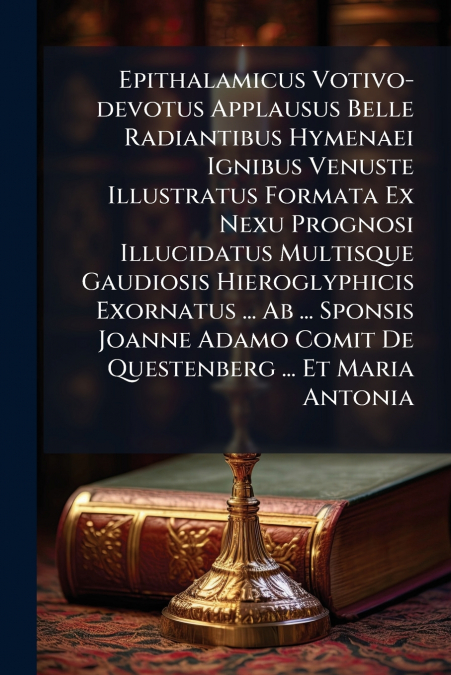
Epithalamicus Votivo-devotus Applausus Belle Radiantibus Hymenaei Ignibus Venuste Illustratus Formata Ex Nexu Prognosi Illucidatus Multisque Gaudiosis Hieroglyphicis Exornatus ... Ab ... Sponsis Joanne Adamo Comit De Questenberg ... Et Maria Antonia is a Renaissance-era epithalamium, a poem written specifically for a wedding. This anonymous work celebrates the marriage of Joannes Adamus Comit De Questenberg and Maria Antonia, employing elaborate and ornate language typical of the period. The poem is rich with religious imagery and symbolism, reflecting the deep spiritual significance attached to marriage within Christian theology at the time. It offers readers a glimpse into the societal values and artistic expressions surrounding marital unions during the Renaissance, making it a valuable piece for those interested in historical literature, religious poetry, and the cultural history of marriage.This work has been selected by scholars as being culturally important, and is part of the knowledge base of civilization as we know it. This work was reproduced from the original artifact, and remains as true to the original work as possible. Therefore, you will see the original copyright references, library stamps (as most of these works have been housed in our most important libraries around the world), and other notations in the work.This work is in the public domain in the United States of America, and possibly other nations. Within the United States, you may freely copy and distribute this work, as no entity (individual or corporate) has a copyright on the body of the work.As a reproduction of a historical artifact, this work may contain missing or blurred pages, poor pictures, errant marks, etc. Scholars believe, and we concur, that this work is important enough to be preserved, reproduced, and made generally available to the public. We appreciate your support of the preservation process, and thank you for being an important part of keeping this knowledge alive and relevant.