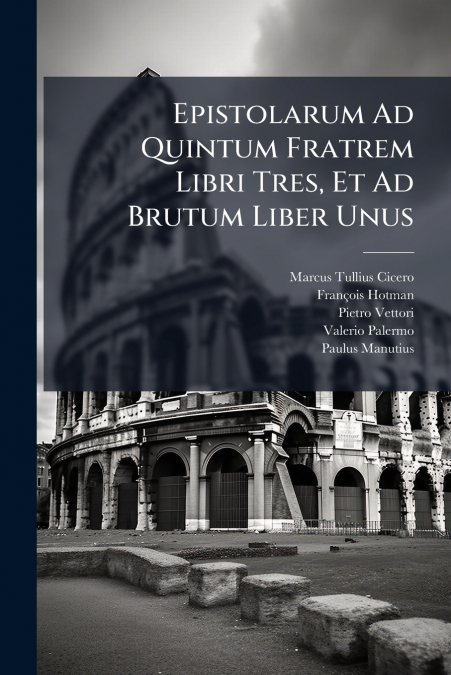
Marcus Tullius Cicero / Pietro Vettori / François Hotman (sieur de la Tour)
 Librería Samer Atenea
 Kálamo Books
 Librería Elías (Asturias)
 Librería Kolima (Madrid)
 Librería Proteo (Málaga)
Epistolarum Ad Quintum Fratrem Libri Tres, Et Ad Brutum Liber Unus presents a collection of letters by Marcus Tullius Cicero, a towering figure in Roman history and literature. These letters, addressed to his brother Quintus and to Brutus, offer invaluable insights into the political, social, and personal life of Cicero and the late Roman Republic. Edited and annotated by prominent scholars including François Hotman, Pietro Vettori, Valerio Palermo, and Paulus Manutius, this edition provides a rich textual resource for students and scholars of classical literature and Roman history.Cicero’s correspondence reveals his thoughts on governance, philosophy, and the tumultuous events of his time, making this collection an essential primary source for understanding the complexities of the era. The letters showcase Cicero’s masterful command of language and rhetoric, further solidifying his legacy as one of history’s greatest orators and thinkers.This work has been selected by scholars as being culturally important, and is part of the knowledge base of civilization as we know it. This work was reproduced from the original artifact, and remains as true to the original work as possible. Therefore, you will see the original copyright references, library stamps (as most of these works have been housed in our most important libraries around the world), and other notations in the work.This work is in the public domain in the United States of America, and possibly other nations. Within the United States, you may freely copy and distribute this work, as no entity (individual or corporate) has a copyright on the body of the work.As a reproduction of a historical artifact, this work may contain missing or blurred pages, poor pictures, errant marks, etc. Scholars believe, and we concur, that this work is important enough to be preserved, reproduced, and made generally available to the public. We appreciate your support of the preservation process, and thank you for being an important part of keeping this knowledge alive and relevant.