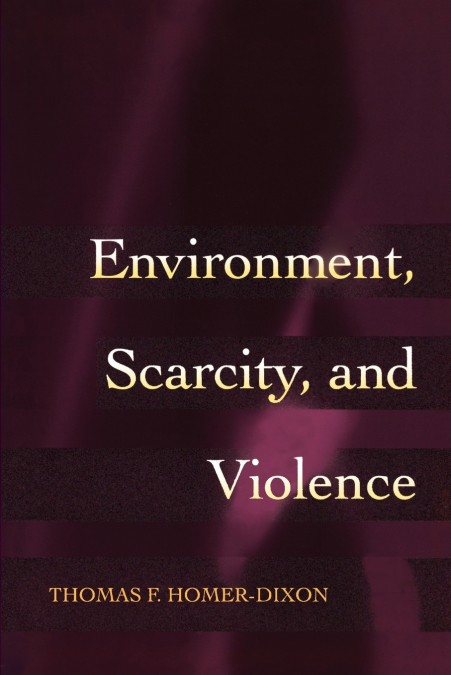
Environment, Scarcity, and Violence

Environment, Scarcity, and Violence

Thomas F. Homer-Dixon / Thomas FHomer-Dixon

68,09 €
IVA incluido
Disponible
Editorial:
Princeton University Press
Año de edición:
2001
Materia
Relaciones internacionales
ISBN:
9780691089799
68,09 €
IVA incluido
Disponible

Selecciona una librería:

  • Librería Samer Atenea
  • Librería Aciertas (Toledo)
  • Kálamo Books
  • Librería Perelló (Valencia)
  • Librería Elías (Asturias)
  • Donde los libros
  • Librería Kolima (Madrid)
  • Librería Proteo (Málaga)

The Earth’s human population is expected to pass eight billion by the year 2025, while rapid growth in the global economy will spur ever increasing demands for natural resources. The world will consequently face growing scarcities of such vital renewable resources as cropland, fresh water, and forests. Thomas Homer-Dixon argues in this sobering book that these environmental scarcities will have profound social consequences--contributing to insurrections, ethnic clashes, urban unrest, and other forms of civil violence, especially in the developing world. Homer-Dixon synthesizes work from a wide range of international research projects to develop a detailed model of the sources of environmental scarcity. He refers to water shortages in China, population growth in sub-Saharan Africa, and land distribution in Mexico, for example, to show that scarcities stem from the degradation and depletion of renewable resources, the increased demand for these resources, and/or their unequal distribution. He shows that these scarcities can lead to deepened poverty, large-scale migrations, sharpened social cleavages, and weakened institutions. And he describes the kinds of violence that can result from these social effects, arguing that conflicts in Chiapas, Mexico and ongoing turmoil in many African and Asian countries, for instance, are already partly a consequence of scarcity. Homer-Dixon is careful to point out that the effects of environmental scarcity are indirect and act in combination with other social, political, and economic stresses. He also acknowledges that human ingenuity can reduce the likelihood of conflict, particularly in countries with efficient markets, capable states, and an educated populace. But he argues that the violent consequences of scarcity should not be underestimated--especially when about half the world’s population depends directly on local renewables for their day-to-day well-being. In the next decades, he writes, growing scarcities will affect billions of people with unprecedented severity and at an unparalleled scale and pace. Clearly written and forcefully argued, this book will become the standard work on the complex relationship between environmental scarcities and human violence.

Artículos relacionados

  • Realism in Practice
    The purpose of this book is to appraise the current relevance and validity of realism as an interpretative tool in contemporary International Relations. All chapters of the book are animated by a theoretical effort to define the conceptual aspects of realism and attempt to establish whether the tradition still provides the necessary conceptual tools to scholars.The chapters add...
    Disponible

    20,36 €

  • Predicting gender violence in India
    Shritha K Vasudevan
    In this provocative new book, Shritha Vasudevan argues that feminist international relations (IR) theory has inadvertently resulted in a biased worldview, the very opposite of what feminist IR set out to try to rectify. This book contests theoretical presumptions of Western feminist IR and attempts to reformulate it in contexts of non-Western cultures. Vasudevan deftly utilizes...
  • Contemporary security issues in Africa
    Isiaka Alani Badmus / Lere Amusan
    In volume, an emerging generation of African scholars examines specific states in Africa where instability is the order of the day. Considerations of African instability are highly relevant in today’s world, where one examines the types of regimes that were put in place after the Cold War and their effects on Africa. Multiparty systems introduced in Africa, rather than bringing...
  • Chronicles of the first and second chechen wars
    Ilya Milyukov
    Presented by Russian author and attorney Ilya Milyukov, Chronicles of the First and Second Chechen War presents the main events of the First (1994-1996) and Second (1999-2009) Wars in Chechnya, Russia’s deadliest conflicts since World War II. The First War began in December 1994 and lasted for one year and nine months, ending in August 1996. There were two major urban battles -...
  • Political instability in Africa
    Isiaka Alani Badmus / Lere Amusan
    This book offers broad-gauged analyses of the causes, nature, and changing patterns of armed conflict in Africa as well as the reasons for these patterns. It also situates conflicts that have been haunting the African continent since the time of decolonization within the various theoretical schools such as 'new war,' 'economic war,' 'neo-patrimonial,' and 'globalization.' It be...
  • Subjugate or exterminate!
    Akhmed Zakaev / Arch Tait
    Foreword by Luke HardingAkhmed Zakaev is a symbol of the indomitable will of the Chechen nation. In this important memoir, he tells the story of the Chechen struggle as he experienced it, describing the conflict in human terms and providing a detailed documentary record of little known or badly understood events that will be of benefit to historians for generations to come.- Da...
    Disponible

    41,63 €