Inicio > Sociedad y ciencias sociales > Política y gobierno > Relaciones internacionales > Environment and Resource Policies for the Integrated World Economy
Environment and Resource Policies for the Integrated World Economy

Environment and Resource Policies for the Integrated World Economy

Richard N. Cooper

29,60 €
IVA incluido
Disponible
Editorial:
Bloomsbury Publishing plc
Año de edición:
1994
Materia
Relaciones internacionales
ISBN:
9780815715450
29,60 €
IVA incluido
Disponible

Selecciona una librería:

  • Librería Samer Atenea
  • Librería Aciertas (Toledo)
  • Kálamo Books
  • Librería Perelló (Valencia)
  • Librería Elías (Asturias)
  • Donde los libros
  • Librería Kolima (Madrid)
  • Librería Proteo (Málaga)

'To whom do the Earth's riches belong—all of mankind, the nations in which those riches are found, or individuals? Why should a relatively small number of Arabs own most of the world's oil reserves? Why should South Africans own most of the world's gold and diamond resources? Or why should the Americans and Canadians own the agriculturally rich Great Plains? Shouldn't these resources and the environment be treated as endowments available to all mankind?Long ago, the international community agreed to a system of national ownership of natural resources, giving states sovereignty over their respective territories. In recent years, however, environmentalists have raised questions about this distribution of property rights with respect to global environmental issues, such as atmospheric disposal of waste gases, preservation of the Earth's genetic material, and the destruction of tropical rain forests. When environmental impacts are global, international action may be warranted to ensure that individual nations are complying with transnational standards.In this book, part of the Brookings Integrating National Economies series, Richard N. Cooper evaluates the need for international policy action in natural resource and environmental management. Using numerous examples, he illustrates the issues that cause conflict in environment and resources policies. Cooper divides the use of natural resources into three categories and examines the rationale for international action in each. He discusses the use of resources not yet subject to national jurisdiction, such as Antarctica, open oceans, and outer space, and analyzes the effects of national action on other nations via both market and environmental externalities.Taking into account the diversity of individual states' circumstances and priorities, Copper concludes that stiff environmental regulations generally are not the best answer to environmental management. He explains that developing countries a'

Artículos relacionados

  • Realism in Practice
    The purpose of this book is to appraise the current relevance and validity of realism as an interpretative tool in contemporary International Relations. All chapters of the book are animated by a theoretical effort to define the conceptual aspects of realism and attempt to establish whether the tradition still provides the necessary conceptual tools to scholars.The chapters add...
    Disponible

    20,36 €

  • Predicting gender violence in India
    Shritha K Vasudevan
    In this provocative new book, Shritha Vasudevan argues that feminist international relations (IR) theory has inadvertently resulted in a biased worldview, the very opposite of what feminist IR set out to try to rectify. This book contests theoretical presumptions of Western feminist IR and attempts to reformulate it in contexts of non-Western cultures. Vasudevan deftly utilizes...
  • Contemporary security issues in Africa
    Isiaka Alani Badmus / Lere Amusan
    In volume, an emerging generation of African scholars examines specific states in Africa where instability is the order of the day. Considerations of African instability are highly relevant in today’s world, where one examines the types of regimes that were put in place after the Cold War and their effects on Africa. Multiparty systems introduced in Africa, rather than bringing...
  • Chronicles of the first and second chechen wars
    Ilya Milyukov
    Presented by Russian author and attorney Ilya Milyukov, Chronicles of the First and Second Chechen War presents the main events of the First (1994-1996) and Second (1999-2009) Wars in Chechnya, Russia’s deadliest conflicts since World War II. The First War began in December 1994 and lasted for one year and nine months, ending in August 1996. There were two major urban battles -...
  • Political instability in Africa
    Isiaka Alani Badmus / Lere Amusan
    This book offers broad-gauged analyses of the causes, nature, and changing patterns of armed conflict in Africa as well as the reasons for these patterns. It also situates conflicts that have been haunting the African continent since the time of decolonization within the various theoretical schools such as 'new war,' 'economic war,' 'neo-patrimonial,' and 'globalization.' It be...
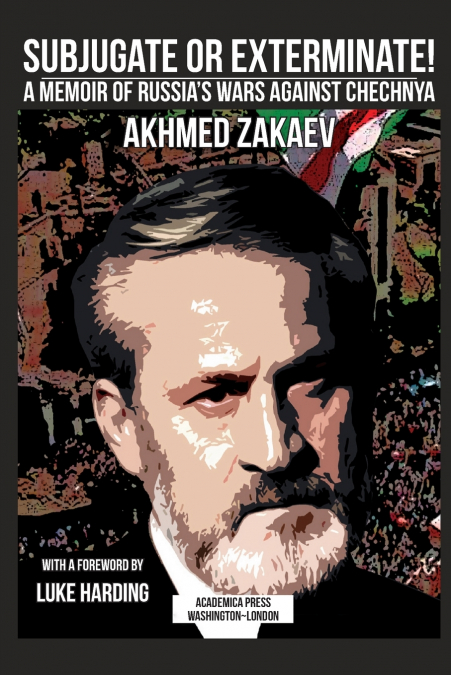
  • Subjugate or exterminate!
    Akhmed Zakaev / Arch Tait
    Foreword by Luke HardingAkhmed Zakaev is a symbol of the indomitable will of the Chechen nation. In this important memoir, he tells the story of the Chechen struggle as he experienced it, describing the conflict in human terms and providing a detailed documentary record of little known or badly understood events that will be of benefit to historians for generations to come.- Da...
    Disponible

    41,63 €