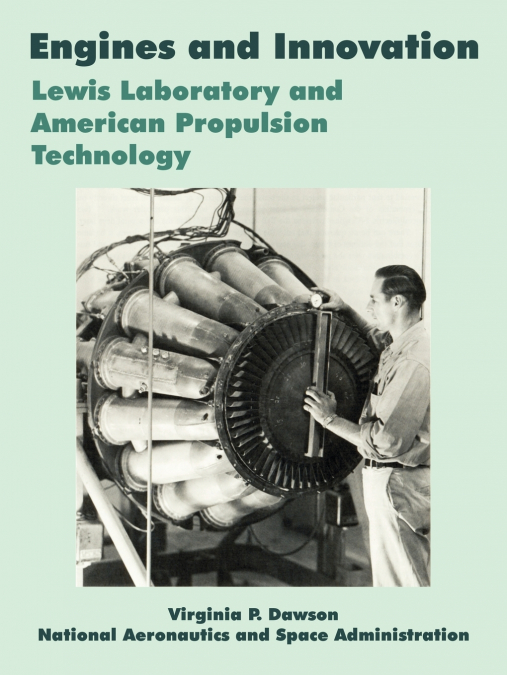
Engines and Innovation

Engines and Innovation

NASA / Virginia P. Dawson / Virginia PDawson

23,46 €
IVA incluido
Disponible
Editorial:
Press Holdings International
Año de edición:
2005
Materia
Tecnología aeroespacial y aeronáutica
ISBN:
9781410220387
23,46 €
IVA incluido
Disponible

Selecciona una librería:

  • Librería Samer Atenea
  • Librería Aciertas (Toledo)
  • Kálamo Books
  • Librería Perelló (Valencia)
  • Librería Elías (Asturias)
  • Donde los libros
  • Librería Kolima (Madrid)
  • Librería Proteo (Málaga)

When Francis Bacon wrote the New Atlantis in the early 17th century, he envisioned a state-supported research institution in which knowledge could be applied to ’enlarge the bounds of Human Empire, to the effecting of all things possible.' Among the research facilities to increase the protection and material comforts of the inhabitants of his imaginary island, Bacon imagined an Engine House to study all types of motion, including flight. National aeronautical research laboratories in Europe and the United States in the early 20th century reflected Bacon’s vision of science applied to the practical problems of flight. Commitment to innovation accompanied Bacon’s belief in progress. His utopia honored inventors, not politicians or academics.In 1941 the same commitment to innovation and industrial progress won federal funding for a laboratory in Cleveland, Ohio. Local and national leaders expected the new laboratory to promote innovations in aircraft engine technology to help win the war against Germany. Contributions to the development of superior engines for military and passenger aircraft after World War II justified the large federal investment in research facilities and personnel. Today this laboratory is the NASA Lewis Research Center. In contrast to the isolation of the ideal research institution of Bacon’s vision, Lewis took shape in a flesh-and-blood world of personalities, national security concerns, and postwar capitalism.Two transitions, both precipitated by advances in propulsion technology, provide the structure for my history: the revolution in jet propulsion during World War II, and the launch of Sputnik in October 1957. Each had significant national political, military, and economic repercussions. Each forced the laboratory to restructure its research program and to redefine its relationships with its three constituencies--the military, industry, and academia. Within this framework I have distinguished one theme that recurs throughout the laboratory’s history--the tension between fundamental or basic research and development. In the process of writing my history I found that these terms could not be defined in any absolute sense. Their meaning is enmeshed in the history of Lewis, and the definitions of research and development changed as Lewis evolved. As an institution, Lewis engaged in a continuing reevaluation of its role within the American propulsion community and, after the formation of NASA in 1958, within a vastly expanded federal bureaucracy.

Artículos relacionados

  • Leverage Dual Space Access Architecture - Advanced Rockets and Space Elevators
    Cathy Swan
    This study assumes Space Elevators can and must be built. 'Space Elevators: The Green Road to Space,' completed in April 2021, emphasizes that Space Elevators will not replace rockets but would join them on parallel paths towards the stars. This Dual Space Access Strategy will carry out the missions that are now planned and ensure the future we dream of becomes a reality. Spac...
    Disponible

    20,30 €

  • Robust Linear Controller Design for Attitude Control of a Rocket
    Sumathi R
    Attitude control of the rocket is a big challenge in real-time. To make the rocket stable against the influences, this book has examined the control technology such as proportional integral derivative control using an anti-windup mechanism and linear quadratic regulator theory based on the degree of freedom mathematical model. The transient behaviour of both controllers is not ...
    Disponible

    98,51 €

  • Small Unmanned Aircraft
    Randal W. Beard / Timothy W. McLain
    Autonomous unmanned air vehicles (UAVs) are critical to current and future military, civil, and commercial operations. Despite their importance, no previous textbook has accessibly introduced UAVs to students in the engineering, computer, and science disciplines--until now. Small Unmanned Aircraft provides a concise but comprehensive description of the key concepts and technolo...
  • Le tour de France en aéroplane
    H. de Graffigny
    Le tour de France en aéroplane, est un livre classique et rare, qui a été considéré comme important tout au long de l’histoire de l’humanité, et pour que cet ouvrage ne soit jamais oublié, chez Alpha Editions, nous avons fait des efforts pour sa préservation en rééditant ce livre dans un format moderne pour les générations présentes et futures. . Tout ce livre a été reformaté, ...
    Disponible

    33,66 €

  • Cybersecurity Issues and Challenges in the Drone Industry
    Cybersecurity Issues and Challenges in the Drone Industry is a comprehensive exploration of the critical cybersecurity problems faced by the rapidly expanding drone industry. With the widespread adoption of drones in military, commercial, and recreational sectors, the need to address cybersecurity concerns has become increasingly urgent. In this book, cybersecurity specialists ...
  • Cybersecurity Issues and Challenges in the Drone Industry
    Cybersecurity Issues and Challenges in the Drone Industry is a comprehensive exploration of the critical cybersecurity problems faced by the rapidly expanding drone industry. With the widespread adoption of drones in military, commercial, and recreational sectors, the need to address cybersecurity concerns has become increasingly urgent. In this book, cybersecurity specialists ...
    Disponible

    275,83 €