Inicio > Derecho > Derecho internacional > Energy Law and Economics
Energy Law and Economics

Energy Law and Economics


221,32 €
IVA incluido
Consulta disponibilidad
Editorial:
Springer Nature B.V.
Año de edición:
2018
Materia
Derecho internacional
ISBN:
9783319746357

Selecciona una librería:

  • Librería Samer Atenea
  • Librería Aciertas (Toledo)
  • Kálamo Books
  • Librería Perelló (Valencia)
  • Librería Elías (Asturias)
  • Donde los libros
  • Librería Kolima (Madrid)
  • Librería Proteo (Málaga)

This book offers an edited volume for all readers who wish to gain an in-depth grasp of the economic analysis of recent developments in energy law and policy in Europe and the United States. In response to waning resources and heightened environmental awareness, many countries are now seeking to redefine their energy mix. Several energy sources are available: coal and oil, natural gas, and a variety of renewables. Yet which of them are capable of addressing core energy-related concerns? Reliability, security, affordability, fairness, and sustainability all have to be taken into account. Further, once a target mix has been identified, two challenges remain for legal scholars: what role does the law play in achieving a specified energy mix, and, how can the law best fulfill that role? The essential energy concerns are just as important in defining the way we shape our energy mix as they are in defining the mix itself.An example of current challenges in energy law and policy can be seen in the pursuit by the German and Swiss governments of the so-called 'Energiewende' (energy transition). These policies are intended to enable the transition from a non-sustainable use of fossil and nuclear energy to a more sustainable approach based on renewable energies. On the one hand, the goal is to achieve a decarbonization of the energy economy by reducing the use of fossil energy sources such as petroleum, carbon and natural gas. On the other, and in response to the Fukushima nuclear accident, a phase out is intended to eliminate the dangers of nuclear technologies. Achieving these goals poses tremendous challenges for the two countries’ energy policies - partly because the energy transition will not only affect energy production, but also energy consumption.From a Law and Economics perspective, a number of questions arise: to what extent is it justifiable to rely on markets and continued technological innovation, especially with regard to the present exploitation of scarce resources? To what extent is it necessary for states to intervene in energy markets? Regulatory instruments are available to create and maintain more sustainable societies: command and control regulations, restraints, Pigovian taxes, emission certificates, nudging policies, and more. If regulation in a certain legal field is necessary, which policies and methods will most effectively spur the sustainable consumption and production of energy in order to protect the environment while mitigating any potential negative impacts on economic development? Do neoclassical and behavioural economics provide us with a suitable framework for predicting the market’s complex reactions to a changing energy policy? This book provides theoretical insights as well as empirical findings in order to answer these vital questions.
Artículos relacionados

  • Comparative regulation, economic analysis, and applications of private equity in the united states and european union
    Irini Liakopoulou
    The present work examines the economics and legal doctrine of private equity. After a consideration of private equity’s origins, the book will explore the evolution of private equity in the United States and Europe. The reference economic model then will be reconstructed, with particular attention to financial flows to and from private equity firms and funds. This reconstructio...
  • Complicity in International Law
    Dimitris Liakopoulous
    Complicity in International Law aims to analyze questions arising from a state’s complicity in conflict with another state or an international organization. On the basis of international legal provisions, a state that assists the illicit fact of another state or an international organization in turn commits an offense if it is aware of the main fact and is bound by the same obl...
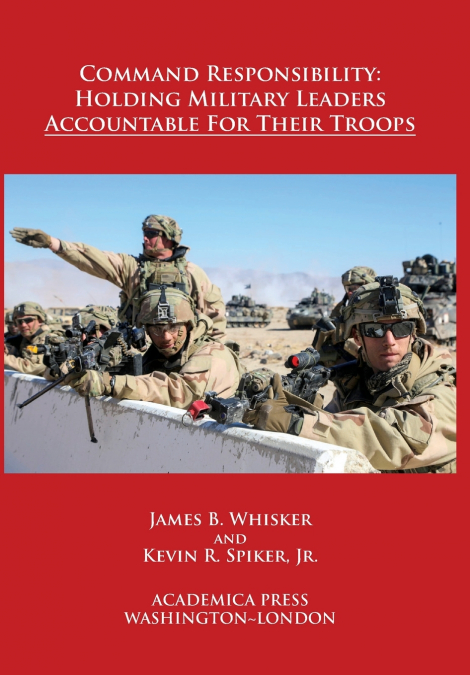
  • Command responsibility
    James B Whisker / Kevin R Spiker
    Command responsibility, or executive accountability, assumes that leaders are responsible for the actions of their subordinates. If subordinates misbehave, violate basic moral laws, transgress international law, or thwart international standards of behavior, their leader may be called before to justice. Standards that set the boundaries of human action have been evolving for ma...
  • International Organizations and Reparations
    Dimitris Liakopoulos
    In the first part of this book, noted legal scholar Dimtris Liakopoulos deals with reconstructing the legal regulatory framework governing human rights violations in the activities of organizations. After identifying rules that are generally applicable to organizations’ offenses and govern the profile of reparations, this study assesses primary rules that guarantee the right to...
  • International Organizations and Legal Sanctions Against Governments
    Dimitris Liakopoulos
    This book examines the relationship between governments and international organizations under international law. After surveying the policing powers of international organizations under international law, it illustrates some normative aspects of law that distinguish regulation from enforcement via study of recent legal cases before international judicial bodies. According to Di...
  • The EU Foreign Subsidies Regulation
    Andreas Reindl / Isabelle Van Damme
    'The EU Foreign Subsidies Regulation' is a pioneering manual authored by legal experts Andreas Reindl and Isabelle Van Damme. This essential guide, the first of its kind, is tailored for legal practitioners, offering a thorough exploration of the tools and mechanisms embedded within this novel European regulatory framework. The authors meticulously dissect the EU Foreign Subsid...