 Librería Samer Atenea
 Kálamo Books
 Librería Elías (Asturias)
 Librería Kolima (Madrid)
 Librería Proteo (Málaga)
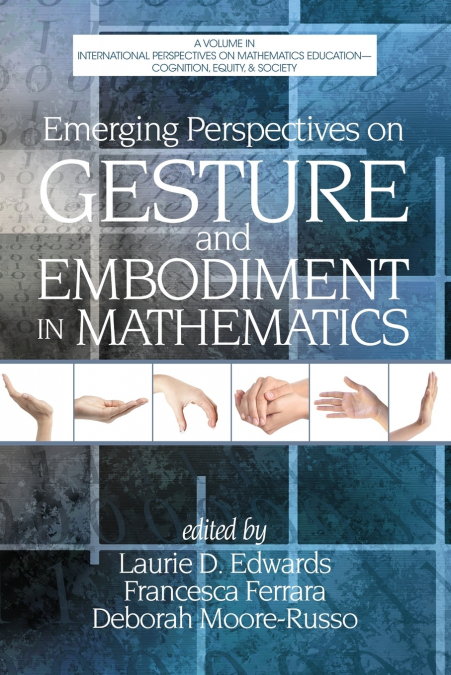
A Volume in International Perspectives on Mathematics Education- Cognition, Equity & SocietySeries Editor Bharath Sriraman, The University of Montana and Lyn English, QueenslandUniversity of TechnologyThe purpose of the book is to consider embodiment as it applies to mathematical thinking, and tolink mathematics education research to recent work in gesture studies, cognitive linguistics andthe theory of embodied cognition. Just as in past decades, mathematics education experienced a'turn to the social' in which socio-cultural factors were explored, in recent years there has been anascent 'turn to the body.' An increasing number of researchers and theorists in mathematics education have become interested in thefact that, although mathematics may be socially constructed, this construction is not arbitrary or unconstrained, but rather is rooted in,and shaped by, the body. All those who engage with mathematics, whether at an elementary or advanced level, share the same basic biologicaland cognitive capabilities, as well as certain common physical experiences that come with being humans living in a materialworld. In addition, the doing and communicating of mathematics is never a purely intellectual activity: it involves a wide range ofbodily actions, from committing inscriptions to paper or whiteboard, to speaking, listening, gesturing and gazing. This volume willpresent recent research on gesture and mathematics, within a framework that addresses several levels of mathematical development,including early number sense, high-school topics, and university-level concepts.The overall goal for the volume is to acknowledge the multimodal nature of mathematicalknowing, and to contribute to the creation of a model of the interactions and mutual influencesof bodily motion, spatial thinking, gesture, speech and external inscriptions on mathematicalthinking, communication and learning. The intended audience is researchers andtheorists in mathematics education as well as graduate students in the field.