 Librería Samer Atenea
 Kálamo Books
 Librería Elías (Asturias)
 Librería Kolima (Madrid)
 Librería Proteo (Málaga)
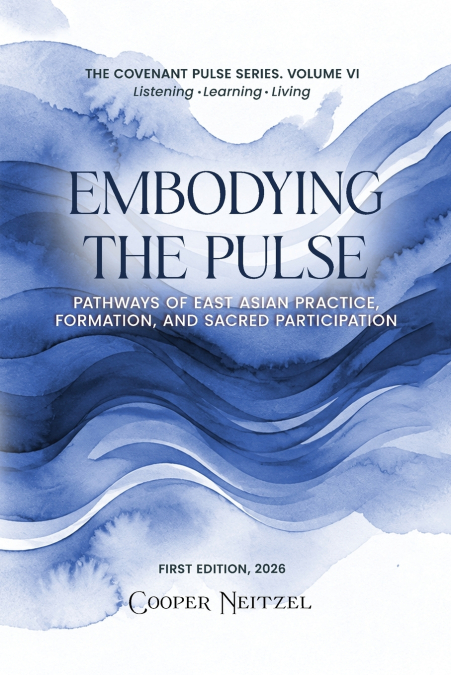
Every community, household, and religious tradition forms its participants through repeated acts, inherited instructions, and shared responsibilities. Beginning with a personal desire to receive a weekly worship observance more knowingly, Embodying the Pulse asks: What are our familiar practices teaching us to notice, to want, and to become?Using the guiding image of a house with many rooms and corridors, this sixth volume of The Covenant Pulse Series enters four distinct East Asian worlds, listening to their primary texts, historical developments, and internal debates on their own terms:Confucianism: Examine moral and ritual formation through the Analects, the Mencius, the Xunzi, and Zhu Xi’s twelfth-century household manual (Family Rituals), tracing how filial care, ancestral offerings, mourning rites, and household order shape human character and social standing.Daoism: Reconsider naming, guidance, and naturalness (ziran) alongside noncoercive action (wu wei) through the Daodejing, the Zhuangzi, the bodily and breath cultivation verses of the Neiye (Inward Training), the inner alchemy of the Wuzhen pian, and contemporary monastic labor and meditation at Beijing’s White Cloud Temple.East Asian Buddhism: Follow scriptures, monastic codes, and devotional paths across India, China, Korea, and Japan from the Lotus Sutra, Huayan interpenetration, and Uisang’s Diagram of the Dharma-Realm to Song-dynasty Chan debates over silent illumination, Zongze’s Chanyuan qinggui, Dogen’s instructions for the monastic cook (tenzo), and Shinran’s Pure Land teaching on Other Power and reciting the Name (nembutsu).Shinto and Japanese Sacred Practice: Trace court ritual prayers (norito) from the tenth-century Engi-shiki, offerings to kami of particular places, purification rites, medieval shrine-temple complexes (jinguji) at Ise and Mount Miwa, and the profound institutional shifts of the 1868 separation of gods and Buddhas and Meiji-era shrine administration.Structured around four enduring questions Way (what orients a life), Relation (where persons are located), Cultivation (what repeated practice forms), and Harmony (what counts as fitting participation) Embodying the Pulse equips readers of any religious or nonreligious background to return to their own commitments with sharper attention, deeper gratitude for those who sustain shared practices, and clearer discernment about how inherited patterns shape human lives.