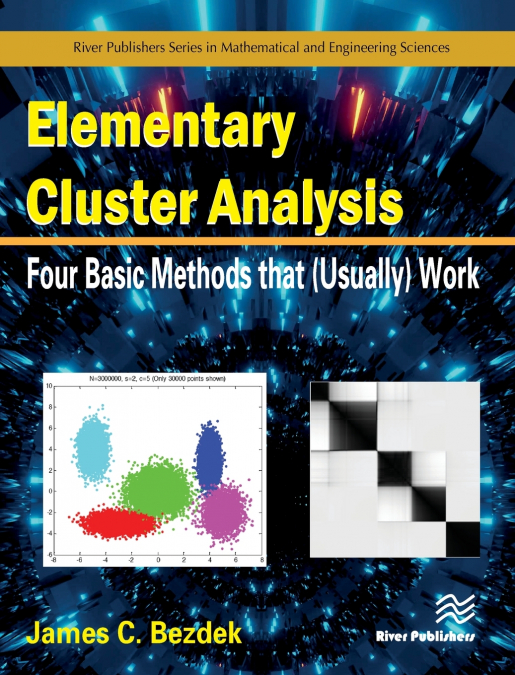

Elementary Cluster Analysis

Elementary Cluster Analysis

James C. Bezdek

222,46 €
IVA incluido
Consulta disponibilidad
Editorial:
Taylor & Francis Ltd
Año de edición:
2022
Materia
Tecnología: cuestiones generales
ISBN:
9788770224253

Selecciona una librería:

  • Librería Samer Atenea
  • Librería Aciertas (Toledo)
  • Kálamo Books
  • Librería Perelló (Valencia)
  • Librería Elías (Asturias)
  • Donde los libros
  • Librería Kolima (Madrid)
  • Librería Proteo (Málaga)

The availability of packaged clustering programs means that anyone with data can easily do cluster analysis on it. But many users of this technology don’t fully appreciate its many hidden dangers. In today’s world of 'grab and go algorithms,' part of my motivation for writing this book is to provide users with a set of cautionary tales about cluster analysis, for it is very much an art as well as a science, and it is easy to stumble if you don’t understand its pitfalls. Indeed, it is easy to trip over them even if you do! The parenthetical word usually in the title is very important, because all clustering algorithms can and do fail from time to time. Modern cluster analysis has become so technically intricate that it is often hard for the beginner or the non-specialist to appreciate and understand its many hidden dangers. Here’s how Yogi Berra put it, and he was right:In theory there’s no difference between theory and practice. In practice, there is ~Yogi BerraThis book is a step backwards, to four classical methods for clustering in small, static data sets that have all withstood the tests of time. The youngest of the four methods is now almost 50 years old:Gaussian Mixture Decomposition (GMD, 1898) SAHN Clustering (principally single linkage (SL, 1909))Hard c-means (HCM, 1956, also widely known as (aka) 'k-means')Fuzzy c-means (FCM, 1973, reduces to HCM in a certain limit)The dates are the first known writing (to me, anyway) about these four models. I am (with apologies to Marvel Comics) very comfortable in calling HCM, FCM, GMD and SL the Fantastic Four. Cluster analysis is a vast topic. The overall picture in clustering is quite overwhelming, so any attempt to swim at the deep end of the pool in even a very specialized subfield requires a lot of training. But we all start out at the shallow end (or at least that’s where we should start!), and this book is aimed squarely at teaching toddlers not to be afraid of the water. There is no section of this book that, if explored in real depth, cannot be expanded into its own volume. So, if your needs are for an in-depth treatment of all the latest developments in any topic in this volume, the best I can do - what I will try to do anyway - is lead you to the pool, and show you where to jump in.


Artículos relacionados

  • Science and the Big Issues of Our Time
    Martin Gellender
    Within the last few generations, our world has been shaped by technological change enabled by scientific advances. This is particularly evident to the 'baby boomer' generation, who have lived through and witnessed huge changes in society over the course of their lifetimes. Although many have little education in science, or have forgotten what they learned in high school, they u...
    Disponible

    26,58 €

  • Statics+++
    James W Dally / Robert J Bonenberger
    This textbook has been prepared to support a course offering for Statics at the University of Nevada at Reno.  Statics provides the first exposure of engineering students to the study of mechanics.  While Statics is a relatively simple subject, many students find it difficult, and they often perform far below our expectations.  In an effort to improve the curriculum, several me...
    Disponible

    101,22 €

  • Technical Writing, Presentational Skills, and Online Communication
    Raymond Greenlaw
    This book addresses four main topics: professional ethics, technical writing, presentation skills, and online writing. These topics are woven throughout the book and some of them are the main subjects of one or more chapters. The overarching theme of this book is to provide well-tested, best-practice techniques and strategies for main topic areas while focusing on information t...
  • Project Management Techniques and Innovations in Information Technology
    John Wang
    Managing cost, time, and quality of a project can be a challenging task for any project manager, but especially in times of an ever-changing and burgeoning field of IT. Project Management Techniques and Innovations in Information Technology offers a vital compendium of the latest research, case studies, best practices, and methodologies within the field of IT project management...
  • Phenomenology, Organizational Politics, and IT Design
    Information systems are researched, published on, and utilized as an extremely broad and vital sector of current technology development, usually studied from the scientific or technological viewpoints therein. Phenomenology, Organizational Politics, and IT Design: The Social Study of Information Systems offers a new look at the latest research and critical issues within the fie...
  • Geotechnical Applications for Earthquake Engineering
    Disaster preparedness and response management is a burgeoning field of technological research, and staying abreast of the latest developments within the field is a difficult task. Geotechnical Applications for Earthquake Engineering: Research Advancements has collected chapters from experts from around the world in a variety of applications, frameworks, and methodologies, and p...