
Inicio > Humanidades > Filosofía > El proceso de Sócrates: Del “nosotros” al “yo”. Contra el prejuicio individualista no percibido
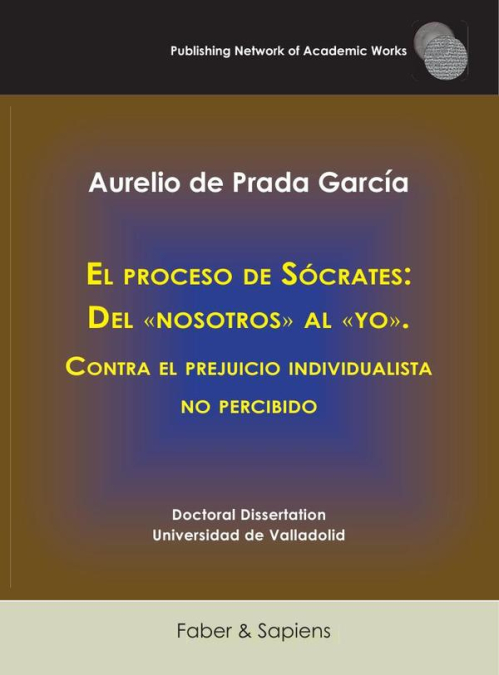
El proceso de Sócrates: Del “nosotros” al “yo”. Contra el prejuicio individualista no percibido

El proceso de Sócrates: Del “nosotros” al “yo”. Contra el prejuicio individualista no percibido

Aurelio de Prada García

18,00 €
IVA incluido
Disponible
Editorial:
APEIRON
Año de edición:
2022
Materia
Filosofía
ISBN:
9788412628340
18,00 €
IVA incluido
Disponible

Selecciona una librería:

  • Librería Samer Atenea

  • Kálamo Books
  • Librería Elías (Asturias)
  • Librería Kolima (Madrid)
  • Librería Proteo (Málaga)

La aplicación de un «prejuicio no percibido» (en el sentido de la hermenéutica de Gadamer), de carácter individualista, nos habría impedido apreciar que, en el procedimiento utilizado en el juicio contra Sócrates, subyacía una forma de entender la identidad completamente diferente de la que subyace a nuestros procedimientos judiciales. Una forma dualista: «uno de nosotros», propia y colectiva al mismo tiempo, que habría sido formulada canónicamente por Aristóteles y que habríamos tergiversado completamente al extrapolar nuestra forma individualista de entender la identidad y considerar equivalentes «uno de nosotros» e «individuo». Todo ello habría tenido como consecuencia no solo tergiversar las actitudes adoptadas por Sócrates en dicho proceso —que habrían de entenderse, más bien, como el paso de la forma de identidad dualista a la nuestra individualista, del «nosotros» al «yo», y luego a la síntesis entre ambas: «Yo, Sócrates, uno de nosotros»—, sino también malinterpretar la forma de entender la identidad en la cultura griega clásica e, incluso, tergiversar teorías políticas posteriores como El contrato social de Rousseau al que asimismo se habría aplicado dicho prejuicio individualista no percibido.

Artículos relacionados

  • Introduction to a Future Way of Thought
    Kostas Axelos / Kenneth Mills
    'Technologists only change the world in various ways in generalized indifference; the point is to think the world and interpret the changes in its unfathomability, to perceive and experience the difference binding being to the nothing.'Anticipating the age of planetary technology Kostas Axelos, a Greek-French philosopher, approaches the technological question in this book, firs...
    Disponible

    20,64 €

  • Capsule
    John Kenneth Press
    Join John and Adam as they wander the mean streets of Japan on a psychedelic fueled search for identity. While fun for the average reader, this book could also serve as a philosphy textbook because of its ordered exploration of sources of identity. Ultimately this trip through nationalist attacks, sex, and drugs, will take you to a better understanding of yourself and your pl...
    Disponible

    13,44 €

  • If you look at it long enough...
    Paul Hallam
    Originally written for an academic journal, If you look at it long enough... is primarily a personal account of Paul Hallam’s recollections of “self-abuse” through the consumption of porn over several decades. Challenging the familiar form of an “academic essay,” this autobiographical narrative raises several questions in relation to our contemporary morals related to sex in ge...
    Disponible

    13,72 €

  • The Teachers of Gurdjieff
    Rafael Lafort / Rafael Lefort
    When The Teachers of Gurdjieff was first published more than 50 years ago, it made a considerable stir. George Ivanovich Gurdjieff had been one of the most famous mystics in the West in the first half of the 20th century - a teaching master who had many fashionable and influential pupils. He had a striking appearance and manner of teaching, and his teaching proved to be very in...
    Disponible

    22,79 €

  • Manifesto of the Communist Party
    Karl Marx
    The Communist Manifesto was first published on February 21, and it is one of the world’s most influential political tracts. Commissioned by the Communist League and written by communist theorists Karl Marx and Friedrich Engels, it laid out the League’s purposes and program. The Manifesto suggested a course of action for a proletarian (working class) revolution to overthrow the ...
  • The Art of Literature
    Arthur Schopenhauer
    Collected here are eight short essays, On Authorship, On Style, On the Study of Latin, On Men of Learning, On Thinking for Ones Self, On Criticism, On Reputation, On Genius, by the world renowned philosopher Arthur Achopenhauer. ...