

George Howard 1864- [from old c Parker
 Librería Samer Atenea
 Kálamo Books
 Librería Elías (Asturias)
 Librería Kolima (Madrid)
 Librería Proteo (Málaga)
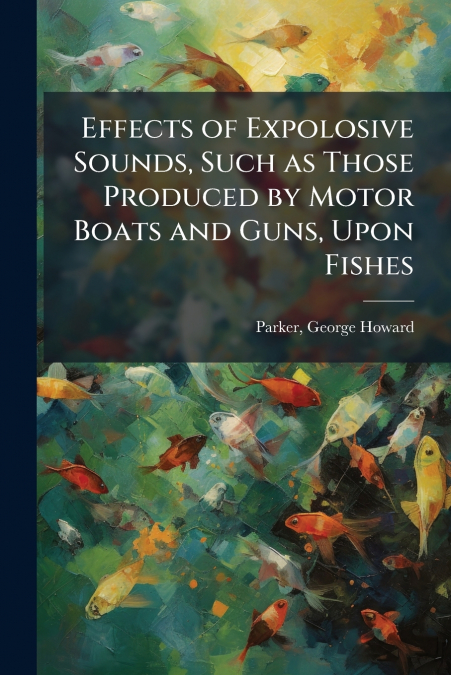
Originally published in 1911, 'Effects of Explosive Sounds, Such as Those Produced by Motor Boats and Guns, Upon Fishes' by George Howard Parker presents a meticulous early study into the impact of man-made noise on aquatic life. This research details experiments conducted to observe how fish react to the concussive forces and auditory disturbances created by explosions. Parker’s work is invaluable for its pioneering approach to understanding ecological consequences of human activity. The text delves into the specifics of sound propagation in water and its physiological effects on fish, providing insights that remain relevant to contemporary discussions on environmental conservation and the impact of noise pollution on marine ecosystems. This historical document offers a foundational understanding of how anthropogenic sounds affect fish populations, underlining the importance of ongoing research in this critical area.This work has been selected by scholars as being culturally important, and is part of the knowledge base of civilization as we know it. This work was reproduced from the original artifact, and remains as true to the original work as possible. Therefore, you will see the original copyright references, library stamps (as most of these works have been housed in our most important libraries around the world), and other notations in the work.This work is in the public domain in the United States of America, and possibly other nations. Within the United States, you may freely copy and distribute this work, as no entity (individual or corporate) has a copyright on the body of the work.As a reproduction of a historical artifact, this work may contain missing or blurred pages, poor pictures, errant marks, etc. Scholars believe, and we concur, that this work is important enough to be preserved, reproduced, and made generally available to the public. We appreciate your support of the preservation process, and thank you for being an important part of keeping this knowledge alive and relevant.





